Showing posts with label travel. Show all posts

Wednesday, September 2, 2020

Storm King sculpture park


In the August 31, 2020 issue of the New Yorker, Peter Schjeldahl, the magazine's art critic, writes about the Storm King sculpture park, located just north of New York City. 

About a year ago, I was lucky enough to visit the park myself, and blogged about the visit here.

Because of social distancing, the park is admitting only 300 visitors each day, using a timed ticket system. The venue will be open until December of this year.

While it is always inspiring to view art in a natural setting, Schjeldahl observes that these days, with our opportunities to look at art so limited, Storm King offers something very special indeed.

Wednesday, March 11, 2020

Colour with a U: conference and exhibition

This promo card features a detail shot of a
gorgeous work by my friend Helena Scheffer

I had been looking forward to the annual conference of SAQA (Studio Art Quilt Associates), to be held in Toronto mid-March. It was to be the first time that the conference for this international organization was booked for a city outside the U.S.

Sadly, with concerns about COVID-19, the conference has been cancelled. Organizers are working hard to ensure that the presentations will be available in a virtual format.

And the exhibition organized to complement the conference will be staged as scheduled. And I am excited to have had a piece accepted. 

I chose this particular piece as one of my three entries, because I felt that the colour palette was indeed unique, and that the Quebec City architecture was distinctive and truly Canadian. 

The show continues until the end of May, and I hope to schedule a few days in the Toronto area to visit with friends and take in the exhibition.

Update: The Homer Watson Gallery is closed indefinitely due to concerns of viral transmission. Please check the gallery website for further information.


Rue de Buade #2

Sunday, October 20, 2019

The New York State Capitol Building

Returning home from a driving holiday in New England, we spent some time in Albany, New York.

Albany is a curious city. As the state capitol of New York, much public money has been spent on its government buildings. The city is almost entirely low-rise, with the exception of some modern governmental skyscrapers, which are poorly-integrated into the landscape of the city centre. They are connected by a cavernous underground plaza, the Nelson A. Rockefeller Empire State Plaza, lacking in amenities or storefronts. The whole complex was built between 1965 and 1976, at an estimated cost of $2 billion.


view of Albany's historic capitol building,
surrounded by modernist government buildings

Here is what architecture critic Martin Filler wrote about the complex, in The Making of Empire State Plaza:
"There is no relationship at all between buildings and site, neither at grade nor atop the podium, since all vestiges of the existing site have been so totally obliterated. Thus, as one stands on the Plaza itself, there is an eerie feeling of detachment. The Mall buildings loom menacingly, like aliens from another galaxy set down on this marble landing strip."
The neighbourhood around the plaza is run-down, and includes a number of condemned buildings. Our innkeeper explained that the people who work for the state are well-paid, and want to live in the suburbs. What she didn't explain was that the centre of the city had been hollowed out by the evictions necessary to accommodate a modernist dream. I found out more about this history by reading the Wikipedia entry here.

Apparently there is a large collection of mid-century art in the complex. I saw only a few examples, and assume that one must enter the various skyscrapers to see the almost 100 sculptures and paintings.

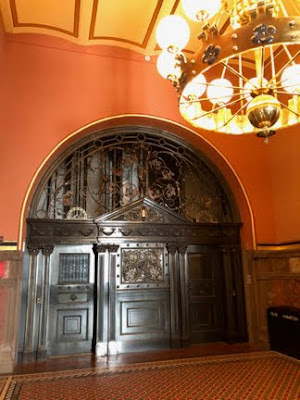
Our hostess recommended a tour of the historic state capitol building. Here are some of the photos I took on the very informative tour.


This image of a hallway underlines the impressive nature
of the state capitol building, built 1867-1899.
The mosaic floor was laid piece-by-piece, by hand.

Examples of fine craftsmanship abound.
Much of the woodcarving was done on site, and the artisans
were mostly immigrants from Scotland.

Many of the materials were also imported, like this panelling of Italian marble.

The state senators meet here, and the galleries are open to the public.
Our guide pointed out some unfinished details in the building, which
was plagued with cost over-runs. The building was declared "finished" in 1899,
at a cost of $25 million, worth almost $800 million today.
It was the most expensive government building of its time.

Originally, the building was to be capped with a dome,
but the idea was scrapped due to structural concerns.

Three successive teams of architects were hired, as costs escalated.
Each team worked in a different architectural style.
Thomas Fuller was the original architect, beginning in 1867
with a Classical/Romanesque style.
He also designed the parliament buildings in Ottawa.
The next two floors were done in a Renaissance Classical style,
and the final work was considered to be Victorian-modified Romanesque.

A second assembly room. The light fixture, seen in part
on the right, weighs twelve tons.

The stonecarving was all done in place.
The capitals of the columns include faces of historic figures,
as well as those of some of the craftsmen.

A tour of the capitol building is offered four times daily, and I would recommend it. Albany also has two worthwhile museums within walking distance, the Albany Institute of History and Art and the New York State Museum.

Wednesday, October 16, 2019

Storm King sculpture park

The southern-most art destination on our recent trip to New England was the Storm King sculpture park in Cornwall, New York. Ever since I learned about this site, I have wanted to experience it for myself. The park is named for its nearby mountain. The project began in 1960, and its 500 acres now receive 200,000 visitors each year.

We arrived on a sunny Sunday afternoon, and it was already busy, though never crowded. Trams travel a circuit to help visitors to reach all corners of the vast space. Rental bikes are also available on site.

Visitors are asked not to touch or stand on the sculptures. Exceptionally, a few are meant to be touched, and they are so labeled in the handout and on the site plaque.


A panoramic view taken from near the hilltop museum building.
The landscape seems to extend endlessly in all directions.

The rolling hills offer many vantage points.

Almost all the sculptures may be viewed up close.
Here is Untitled, by Joel Shapiro, 1994

Black Flag, Alexander Calder, 1974

Visitors enjoy interacting with the sculptures,
sometimes striking a pose for photos.

Here, a viewer performs a physical exam of Three Legged Buddha, by
Zhang Huan, 2007.

Alternate view of Three Legged Buddha. The sculpture weighs
more than 12 tons. The head is a self-portrait of the artist.

Some sculptures were placed in relation to water features,
like Roy Lichtenstein's Mermaid,  1994

An example of land art, Storm King Wavefield by Maya Lin, 2007-8.

Lin's best-known work is no doubt the Vietnam Veterans' Memorial in Washington DC. Storm King Wavefield, above, consists of seven nearly-400-foot-long waves, ranging in height from ten to fifteen feet. It is considered to be an environmental reclamation project, situated on what was once an 11-acre gravel pit that supplied material for the New York State Thruway. The rhythm of the masses replicates the scale of a series of mid-ocean waves.


Another example of land art is Storm King Wall, by Andy Goldsworthy, 1997-98.

The stone wall continues on either side of a small pond, up the hill and into
 the woods. It measures 2278 feet, and is Goldsworthy's largest work to date.

These Ionic columns are massive in scale, and overlook a vista.

Some sculptures interact with each other.
In the foreground, North South East West by Lynda Benglis,
1988/2002/2014-15.

Others relate to the trees and detritus in the woods, or mark the margin between
open ground and forest.
Here, Eight Positive Trees,  Menashe Kadishman,  1977

Other sculptures, like City on the High Mountain, by Louise Nevelson,
are more stand-alone.

The website for Storm King is a rich source of information about all of their 100-plus sculptures. It allows you to search by artist, by title or by decade, and offers details about the making or installation of each piece. 

Wednesday, October 9, 2019

The Frelinghuysen Morris House & Studio

A recent holiday in New England included tours of historic homes, including Hildene House in Manchester, Vermont, home of Robert Lincoln, son of Abraham Lincoln. A memorable part of these tours was the opportunity to walk through forested pathways on the house grounds.

Acres of woodland at The Mount, Edith Wharton's home in Lenox,
are carpeted with periwinkle. In the spring,
when it's blooming with blue flowers, it must be a thrilling sight.

This was our experience as we approached the Frelinghuysen Morris house and studio for our guided tour. I have to ask you to imagine the sensation of the crunchy mulch underfoot, the gentle breeze that rustled the leaves, the fragrance of autumnal decay, the dappled sunlight and the hum of the cicadas. The 46-acre estate also includes a formal garden and a small pond.


The studio space was inspired by Fernand Léger's studio
 in France, as designed by Le Corbusier

George L.K. Morris grew up on these grounds in Lenox, Massachusetts. As a young man from a wealthy family, he pursued an interest in art and was hired by MOMA to travel to Europe and buy work for their collection. He was friendly with the French painter Fernand Léger and others. In the early '30s, he had this studio built for himself on the grounds of the family estate. Around this time he married Suzy Frelinghuysen, an accomplished opera singer and visual artist, and together they enjoyed a privileged life, much of it spent in Europe.  Their own art collection included paintings and sculpture by Léger, Picasso, Miro and Gris, among others.


Entrance hall to house, with Morris's fresco

Within a few years a house was added to the studio, designed by the couple and meant to be a part-time residence. Morris himself painted the frescoes.


The living room, with its original furnishings.
The floor has recently been replaced with new leather tiles, as per the original.
Note Morris' fresco on the wall at right.

The light-filled studio

The visit included a one-hour video documentary on the lives of the couple, and a one-hour tour with a very knowledgeable guide. Go to this link for more information about the Frelinghuysen Morris House and Studio.

Sunday, October 6, 2019

An art-infused holiday in Massachusetts


On a recent "art and culture tour", our first stop in western Massachusetts was Williamstown, just south of the Vermont border. Williamstown is the perfect little college town, as though designed by Disney. It is home to Williams College, established in 1793.


street view as seen from the entrance to the art museum
of Williams College

This liberal arts school, with an enrolment of little more than 2000, has a fine Museum of Art. Teachers in various disciplines (history, religion, biology, among others) select a few pieces from the museum's art collection to augment their required reading lists, and these are displayed at the museum's entrance. In this way, casual visitors like me are given a new perspective on the art collection. As part of a biology class, for example, an Albers colour study might be a topic for discussion on visual perception.


The Williams College campus is bisected
by the main street through town.

The Clark Institute in Williamstown,
with its charming lily pond in the foreground

Next stop in Williamstown was the Clark Art Institute, commonly referred to as "The Clark". The architecture of the building is very striking, and the holdings are impressive. The Clark is best known for its collections of French Impressionist paintings, especially Renoir, as well as some major pieces by John Singer Sargent and by J.M.W. Turner.

John Singer Sargent, Smoke of Ambergris, 1880

Camille Pissarro, Piette's House at Montfoucault, 1874

Camille Pissarro, Route de Versailles, Louveciennes, Rain Effect, 1870

Then it was on to North Adams, home to the Massachusetts Museum of Contemporary Art, better known as  Mass MoCA. While there, we especially enjoyed the immersive light and hologram installations of James Turrell. To get a sense of how this enormous space, formerly industrial, has brought new life to a struggling corner of the state, you might want to watch this:


What else did we see in Massachusetts? The Norman Rockwell Museum in Stockbridge is definitely worth a couple of hours. We had an excellent tour of The Mount, the turn-of-the-century home of author Edith Wharton, that gave us a glimpse into her life and times. Her estate includes formal gardens and fifty acres of beautiful woodland.


The Mount, home to Edith Wharton, in Lenox

We also spent a half-day at the Hancock Shaker Village in Pittsfield MA, where we enjoyed live demonstrations of basket weaving, blacksmithing, and woodworking. We learned about the lives of the 100 or so one-time residents of this religious community by touring their dormitories, schoolroom, farm fields and barns.

There is one more art-themed attraction in Massachusetts that I want to share with you, but it will have to wait for an upcoming post.

Wednesday, October 2, 2019

Art sampling in Vermont

We recently had the good fortune to travel through the Green Mountains of Vermont and the Berkshires of western Massachusetts. The leaves were beginning to turn and the secondary highways offered many interesting art venues to explore. Here is a sampling from the Bennington Museum:

puppets from The King Story, one of Bread and Puppet Theatre's early
 anti-war productions, 1963

The iconic Jane Stickle Sampler Quilt, 1863,
169 five-inch blocks, each a different pattern and fabric.
Stickle, long bed-ridden, won a $2 prize for this entry into the
1863 Bennington County Agricultural Fair. 

Spring in Dover, by Clifford A. Bayard, 1942,
one of several in the American Impressionist display of Vermont landscapes

Ethan Allen to Sulky weathervane, 1870
an example of Vermont folk art

A display of antique toys.
Collections of antique medical instruments, antique needleworking tools and
antique musical instruments made for interesting
displays at the Bennington Museum.

The museum in Bennington has a whole gallery filled with the paintings of Grandma Moses, but alas, no photos are permitted there.


The Southern Vermont Arts Center welcomed us...

... with open arms. Note the mower in the background.

The Southern Vermont Art Centre, in Manchester,
 presented a mix from their permanent collection
and works for sale by contemporary Vermont artists.

There are many excellent art galleries to visit in Vermont. We had intended to check out the work of Pointe Claire artist Susanne Strater at Northern Daughters in Vergennes, and the work of Jane Davies at the Edgewater Gallery in Middlebury.  Sadly, our visit did not coincide with gallery hours.

But we did make it to Bennington Potters, which has a self-guided tour available in their pottery-making facility.


Bennington Potters

Wednesday, August 7, 2019

Photos under consideration

Looking back over files of my photos, I am close to selecting a few more that will serve as inspiration for new cityscapes.

Yes, I know, I said I would never make any more cityscapes. And yet I find myself needing new material to add to some exhibition commitments for the coming season.

Exteriors? Interiors? Perhaps one or two of these images will serve nicely. All were taken last year in Copenhagen.


This photo and the two below were taken in a stairwell of an art museum.
I wish I could remember which museum it was.


As I responded to Jo, who commented on a similar post two weeks ago,
"We have to take our inspiration where we find it, yes? When something speaks to us, that makes it worth following up, I think. And it's also valuable to ask ourselves what it is about the image that has drawn us in. Contrasting scale, contrast of straight vs. curved, contrast of light and dark, the juxtaposition of the human figure against the architectural, rhythmic grids.... It's all there!"