Showing posts with label books. Show all posts

Sunday, March 1, 2020

"Recollections of a Picture Dealer", by Ambroise Vollard

I don't remember exactly where I read a review of this book, a memoir of the well-known Parisian art dealer Ambroise Vollard (1866-1939). But I hesitate to recommend it to anyone but the most avid fan of art history. Perhaps a good biography of Vollard is yet to be written.


Vollard's collection of anecdotes is populated with the colourful characters of the Parisian art scene, including Picasso, Renoir, Cezanne, Manet, Gauguin, Van Gogh and Degas. Also included in his tales are well-known art collectors, like Gertrude Stein and her brother Leo Stein, Henry Osborne Havemeyer and Albert C. Barnes.

A caution: Vollard was very much a man of his time, and his stories are told through the lens of racist and misogynist views. No doubt a shrewd dealer, who generously supported struggling artists, he was not a particularly skilled writer. Nor is the translation especially accomplished. Vollard provides a glimpse into an intriguing world of salons and cafés, of dalliances and betrayals, slights and schemes, but stops short of sharing more thoughtful reflections.


Portrait of Ambroise Vollard, Paul Cezanne, 1899

I think the nature of Vollard's personality was that he was a true collector, not only of art but of people. He was also a "connector", bringing together disparate people with common interests.


Portrait of Ambroise Vollard, Picasso, 1910

In short, Recollections of a Picture Dealer was a disappointment. For an intriguing summary of Vollard's fascinating life and remarkable legacy, have a look at his Wikipedia profile.

Wednesday, February 19, 2020

Landscape Painting Now: from Pop Abstraction to New Romanticism


Published in 2019, this book offers a survey of 21st century landscape painting, a genre often  overlooked in current art criticism. It was edited by Todd Bradway, with an introductory essay by Barry Schwabsky.


Jonas Wood, M.V. Landscape, 2008
oil on canvas, 120 x156 inches

The work of more than 80 artists is presented, divided into six loose categories: Realism and Beyond, Post-Pop Landscapes, New Romanticism, Constructed Realities, Abstracted Topographies, and Complicated Vistas. Each category is defined and explored in a short introductory essay.

The three paintings I have chosen to post here are among my favourites. They are more figurative than much of the work in the book.


Isca Greenfield-Sanders, Bathers, 2016
mixed media oil on canvas, 35 x 35 inches

A couple of paragraphs introduces the work of each artist, both in general terms and with commentary about the specific paintings chosen to illustrate the artist's approach. Each artist has three or more paintings featured, often in full-page format. The quality of the reproduction is excellent.


Tim Eitel, Reflector, 2015
oil on canvas, 86 5/8 x 126 inches

The book ends with biographical information about all the artists. While most are American, there is a fair representation of international painters.

As I read through Landscape Painting Now, I was reminded how landscape painting can deal with contemporary issues, like social isolation, migration, and environmental devastation. 

I found the book in my local library; it's also available from Amazon.

Wednesday, January 8, 2020

Canada and Impressionism: New Horizons

The Westmount Public Library is always obliging about acquiring books I request. Most recently, I suggested they buy "Canada and Impressionism: New Horizons, 1880-1930", the book that accompanies an exhibition of the same name, currently on tour in Europe. This same show will open at Ottawa's National Gallery in the fall of 2020. You can read more about the show on the Gallery's website.


The first of ten essays in the book is the Prologue, written by ex-Montrealer Adam Gopnik. I am a huge fan of Gopnik, who often writes in the New Yorker and occasionally speaks in Montreal.

Here are a few snippets from his insightful essay, titled "Canada and World Impressionism".
 "As modern art becomes for us less a train racing forward than a many-sided landscape to be explored at leisure, and for pleasure, progress becomes a less certain term." 
"Impressionism is a misnamed French movement from the 1860s to the 1880s. Actualisme might have been closer to its true spirit, which was not to record a quick impression of a scene or place but to give permanent form to the ambivalent pleasures of modern life, and in a style shorn of rhetoric and the painstaking pomposity of official art. It was an art about light and life, and how each illuminates the other."
"Light and life, light as it falls and life as it is. Though truth to local colour is no longer the whole of art, it always will be the heart of painting. Any art that chooses light and life as its object and subject, whatever flag it flies, will shine. The best kind is light on life in a winter house on a snowy city evening, drawing us home, even as we stand outside to look a moment longer."

Maurice Cullen, Winter Night, Craig Street, Montreal, 1899

Wednesday, November 27, 2019

"Art and Rivalry", by Carol Bishop-Gwyn

This newly-published book, "Art and Rivalry", is subtitled "The Marriage of Mary and Christopher Pratt". These names will be familiar to many Canadians, as both are iconic Canadian artists.


Mary Pratt (1935-2018) and Christopher Pratt (b. 1935) married young, in 1957, having met in art school. Together they raised four children. This book examines the challenges typically faced by women of the era, who were expected to put aside their professional ambitions so as to better support their husband's career and manage the household. Mary continued to make art even while her children were young, and in later years her career can be seen as eclipsing that of her husband.


Night on the Veranda, Christopher Pratt
silkscreen, 1986

Christmas Eve at 12 o'clock, Christopher Pratt
silkscreen, 1995
Both are important figures in the Atlantic Canada art world, producing prolifically as well as serving on many committees and councils.  Mary held a seat on the Canada Council for six years, and served as a regent for Mount Alison University for eight. She played an important role in the establishment of The Rooms, Newfoundland's premiere art gallery. Christopher accepted the role of curator of the then newly-opened Memorial University Art Gallery, and sat on the board of the Canada Council for the Arts from 1975-1981. For a time, he also taught at Memorial University.

Asarco Abstract #1, Christopher Pratt
oil on board, 2019

Bishop-Gwyn's unauthorized biography is thoroughly researched and rich with detail. Much of her book deals with the complications of married life. Christopher, for example, entered into an affair with one of his young models. When he gave Mary some of his discarded slides featuring the model, she used them to inspire her own portraits of the young woman. The general opinion was that Mary's paintings of the young woman were superior, more full of life and emotion than Chrisopher's studies of the same subject. In many respects the two artists were rivals as well as intimate partners.

Eggs in Egg Crate, Mary Pratt
oil, 1973

Some critics of Mary Pratt's work have found her subject matter mundane and commonplace. Others revel in her celebration of the everyday. Often her subjects suggest "containment", and it is interesting to survey her many paintings with this theme in mind.


Jelly Shelf, Mary Pratt
oil, 1999

Cold Dream, Mary Pratt
oil, 1983
As a young man, Pratt worked summers as a surveyor, and this no doubt contributed to his artistic vision. He favours a flat, full-frontal approach, like that of filmmaker Wes Anderson. Critics of Christopher Pratt's work regret that he so often directed his energies to the medium of silkscreen instead of his oil painting, but it could be that the affordability of his limited edition prints helped to popularize his paintings and raise their value. He continues to sell his prints and paintings through the Mira Godard Gallery.

Carol Bishop-Gwyn has written a fascinating book from a feminist perspective, documenting the personal and professional lives of two important Canadian artists.


Sunday, October 27, 2019

"How Do We Look", by Mary Beard


Published in 2018, this book is barely 200 pages long, but it turns the conventions of art history on its head.

Rather than a parade of (mostly male) artists ("one damn genius after another" is the author's phrase), Mary Beard focuses on the "social history" of art. How did the art function in its society? What purpose did it serve? What does it tell us about its time, and how much does it continue to shape our perceptions today? She shifts the focus from the "maker" of the art to the "audience" of the art.

The author readily admits how much she was influenced by Kenneth Clark and his BBC series "Civilization" (1969), but she broadens the conversation by drawing on references from outside the Western canon, including examples from South America, Asia and the Islamic world. She also turns our gaze to include women artists and artisans, and to explore how art reflects (and fails to reflect) the role of women in the world.

Beard is Professor of Classics at the University of Cambridge, a fellow of Newnham College, and Royal Academy of Arts Professor of Ancient Literature. She is the Classics editor of the Times Literary Supplement. Despite all these impressive titles and her obvious erudition, Beard writes in a most accessible style.

If you're interested in the more modern and inclusive take on art history, this would be a good book to begin with.

And here's an interesting footnote: Mary Beard was a co-presenter for the 2018 BBC update of the Kenneth Clark series, newly titled "Civilizations". But when the series was edited for American PBS, much of her footage was removed. Beard claimed that her appearance as an older woman was unwelcome, and that the series was modified to become more "anodyne". She urges anyone interested to watch the BBC version of "Civilizations".

Wednesday, September 4, 2019

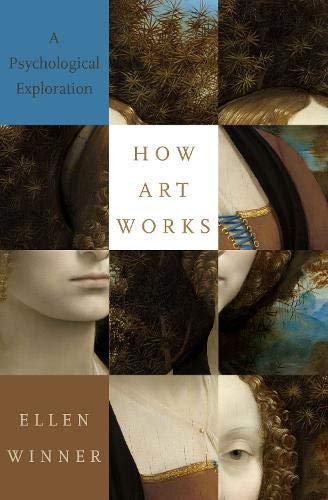
"How Art Works", by Ellen Winner

Have just read How Art Works, published this year by Oxford University Press. The author is a professor of psychology at Boston College, and director of the Arts and Mind Lab. Ellen Winner explores the psychology and philosophy of art in its many forms (music, literature, film...) but I am most interested in what she writes on the topic of visual art.

In Chapter 2, the author describes how Denis Dutton, a philosopher of aesthetics in New Zealand, attempts to answer the question "What is art?"


Dutton proposes that typical works of art, whether musical, literary or visual, have characteristic features:

skill and virtuosity
novelty and creativity
representation
expressive individuality
emotional saturation
direct pleasure
intellectual challenge
imaginative experience
culture of criticism
style
special focus
existing within art traditions and institutions

Let's look at these one by one, and try to think of examples of art that challenge this definition, by not exhibiting the characteristic. (In these instances, the characteristic is not necessary). Also, let's try to think of examples that demonstrate the characteristic but are decidedly not art. (The characteristic is not sufficient).


Marcel Duchamp, Fountain, 1917


1. Skill and Virtuosity

Duchamp's readymades (the urinal, for example) were found objects, so they do not display skill or virtuosity. And something like surgery, which does display skill and virtuosity, is not usually thought of as art. So this feature is not necessary or sufficient, but nevertheless is characteristic of most works of art.


Aphrodite of Milos

2. Novelty and Creativity

Many examples of classical art do not display novelty or creativity, so this is not necessary. Neither is it sufficient. Technological innovation might show novelty and creativity, but it isn't art.


Jean-Paul Riopelle, Perspectives, 1956

3. Representation

Much modern art is non-representative, thus representation is not necessary. And maps and graphs are representative, but not art, and so this quality is not sufficient.

You will be relieved to know that I am not going to continue in this vein, but perhaps you would like to consider for yourself whether each of these twelve characteristics is either necessary or sufficient for your definition of art. Despite the exceptions, I think there is merit in Dutton's idea, in that these qualities do form a cluster of traits that help us distinguish "art" from "not art".

And let's remember too that we're not talking about good art vs. bad art, which is an entirely different issue!

Once Winner sets us up by giving us a loose definition of art, she proceeds to draw on various psychological studies designed to shed light on questions such as:

– Are artists born or made? (Both. Innate talent and thousands of hours of practice are both essential.)

– How can that be art if my two-year-old can make something just like that? (Adults, children and artificial intelligence can distinguish paintings made by artists from paintings made by children or animals about two-thirds of the time.)


– Do art lessons or music lessons impart skills that raise scores on standardized tests? (Regrettably, there is very little evidence to support the theory that these skills transfer to academics. High test scorers tend to participate more in art lessons, sports and community activities, so it's more likely a matter of "drive".)

– Will reading fiction make us more empathetic? (No evidence of this, but there have been some positive indications that role-playing in the classroom can help make us more sympathetic to others.)


The author also explores why we value authenticity in art, and devalue copies and forgeries. Also, how much do we value effort in art (i.e., how long did it take you to make that?)

Interesting questions, but evidence-based studies provide few answers.

Sunday, September 1, 2019

"Life with Picasso", by Françoise Gilot

Last month I posted an item about Françoise Gilot, muse and wife to Picasso. I learned about her through a profile in The New Yorker, in their July 22, 2019 issue. Since then I have read her book, Life with Picasso (McGraw Hill, 1964), and enjoyed it even more than I expected.


Françoise Gilot and Pablo Picasso

Her co-author, Carlton Lake, wrote the foreword to the book, and was clearly impressed by the consistency and detail of Gilot's memories. The book was published barely ten years after she left Picasso.

When they met, Gilot was a young art student. She relates some of the advice Picasso gave her as a beginning artist. For example,
"You know, we need one tool to do one thing, and we should limit ourselves to that one tool. In that way the hand trains itself. It becomes supple and skillful, and that single tool brings with it a sense of measure that is reflected harmoniously in everything we do. The Chinese taught that for a water-colour or a wash drawing you use a single brush. In that way everything you do takes on the same proportion. Harmony is created in the work as a result of that proportion, and in a much more obvious fashion than if you had used brushes of different sizes. Then, too, forcing yourself to use restricted means is the sort of restraint that liberates invention. It obliges you to make a kind of progress than you can't even imagine in advance."
We also learn about some of the aesthetic considerations of Picasso. For example, we see how Picasso celebrated the unexpected in his compositions.

Pablo Picasso, Girl Before a Mirror, 1932

"I start with a head and wind up with an egg. Or even if I start with an egg and wind up with a head, I'm always on the way between the two and I'm never happy with either one or the other. What interests me is to set up what you might call the rapports de grand écart – the most unexpected relationship possible between the things I want to speak about, because there is a certain difficulty in establishing the relationships in just that way, and in that difficulty there is an interest, and in that interest there's a certain tension and for me that tension is a lot more important than the stable equilibrium of harmony, which doesn't interest me at all. Reality must be torn apart in every sense of the word. What people forget is that everything is unique. Nature never produces the same thing twice... a small head on a large body, a large head on a small body.... I want to draw the mind in a direction it's not used to and wake it up.... That's why I stress the dissimilarity, for example, between the left eye and the right eye.... So my purpose is to set things in movement, to provoke this movement by contradictory tensions, opposing forces, and in that tension or opposition, to find the moment which seems most interesting to me."

Pablo Picasso, Woman with Guitar, 1913

We read about Picasso's thoughts on Cubism:
"The papier collé was really the important thing...."
and his reflections on how modern painters must navigate their own paths without the benefit of the Academy:
"Beginning with van Gogh, however great we may be, we are all, in a measure, autodidacts –you might almost say primitive painters. Painters no longer live within a tradition and so each one of us must recreate an entire language.... In a certain sense, there's a liberation but at the same time it's an enormous limitation...."
We learn about the relationships between Picasso and his contemporaries, and about what they thought of each other's work. Gilot recalls the reflections of Matisse on Jackson Pollock:
"I have the impression that I'm incapable of judging painting like that... for the simple reason that one is always unable to judge fairly what follows one's own work. One can judge what has happened before and what comes along at the same time.... But when he gets to the point where he no longer makes any reference to what for me is painting, I can no longer understand him. I can't judge him either. It's completely over my head."

Henri Matisse, The Green Line, 1905


and Matisse's account of how Renoir responded to Matisse's paintings:
"He looked them over with a somewhat disapproving air. Finally he said, 'Well, I must speak the truth. I must say that you're not really a good painter, or even that you're a very bad painter. But there's one thing that prevents me from telling you that. When you put on some black, it stays right there on the canvas. All my life I've been saying that one can't any longer use black without making a hole on the canvas. It's not a color. Now, you speak the language of color. yet you put on black and you make it stick. So, even though I don't like at all what you do, and my inclination would be to tell you you're a bad painter, I suppose you are a painter, after all."

Marc Chagall, La Mariée

An excerpt that I found very amusing was about the mutual regard of Chagall and Picasso. To understand the context, you have to know that it was said during a time when Picasso had let his painting lapse in order to explore lithography, sculpture and ceramics. Picasso is quoted as saying,
"When Matisse dies, Chagall will be the only painter left who understands what color really is. I'm not crazy about those cocks and asses and flying violinists and all the folklore, but his canvases are really painted, not just thrown together. Some of the last things he's done in Vence convince me that there's never been anybody since Renoir who has the feeling for light that Chagall has."
Gilot recounts how, long after that, Chagall gave her his opinion of Pablo.
"What a genius, that Picasso," he said. "It's a pity he doesn't paint."
Of course we learn all about the squabbles between the artists and a good deal about the irascible, difficult and demanding personality of Picasso. And we are skillfully transported to the artistic community of the mid-century Midi.

I would strongly recommend Françoise Gilot's Life with Picasso for anyone who is interested in the French art scene of the 20th century. A good read.

Sunday, August 11, 2019

The compelling story of Françoise Gilot

Here's a fascinating read: the profile of Françoise Gilot written by Alexandra Schwartz  and published in the July 22, 2019 issue of The New Yorker.


In "How Picasso's Muse Became a Master", Schwartz writes:
"Gilot is ninety-seven now; she has been painting nearly as long as Picasso did, and is enjoying something of a revival. In October, I went to Sotheby’s to watch a curator interview her about a new edition, from Taschen, of fanciful travel sketchbooks that she made in Venice, India, and Senegal. Gilot, still beautiful in a navy-blue suit and knotted silk scarf, was lucid, witty, and pitilessly dry in the French way."
Schwartz refers extensively to Gilot's own "remarkable" 1964 memoir, "Life with Picasso", written with the art critic Carlton Lake, and recently reissued by New York Review Books Classics.


In this "Me Too" era, Gilot's story has much to tell the contemporary reader about the challenges inherent in the roles of muse, lover, artist, and independent spirit.

You may be able to access the article through this link.


Wednesday, June 5, 2019

The Secret Lives of Colour by Kassia St. Clair


The basis for The Secret Lives of Colour, an NPR Best Book of 2017, is a collection of columns written by St. Clair for British Elle Decoration. She has created ten broad categories of colour and then profiled six to ten of the most interesting colours in each category.

We learn that some cultures had no words for a particular colour. The ancient Greeks did not recognize blue as a distinct colour, while Koreans have a word that distinguishes yellow-green from standard green. Russians have different words for light and dark blue. Newton's discovery of the colour spectrum eliminated white, black and brown from the discussion. Rembrandt's rich, chocolatey shadows were likely made of all the dregs on his palette. Colour was used to signify social status in many societies, while the Puritans eschewed colour altogether, as did the architect Le Corbusier.

This fascinating book draws upon art history, fashion, chemistry, and the history of commerce and trade to tell 75 most intriguing stories.  One example is "Mummy Brown", a pigment actually made from ground-up mummified bodies. It was sometimes called "Egyptian Brown", and was used in Europe between the 12th and 20th centuries.
"By the beginning of the 20th century demand was so sluggish that a single mummy might provide a paint manufacturer with pigment for a decade or more. C. Roberson, a London art shop that first opened its doors in 1810, finally ran out in the 1960s. 'We might have a few odd limbs lying around somewhere,' the managing director told Time magazine in October 1964, 'but not enough to make any more paint. We sold our last complete mummy some years ago for, I think, £3. Perhaps we shouldn't have. We certainly can't get any more.'"

Wednesday, May 22, 2019

Wow! 200 books on Modern Art now available on line


The Guggenheim has published 200 books on Modern Art on line, available at no cost. You can access them here. And...

... did you know that you can explore every exhibit that MOMA has staged since 1929? You can access this material for free here.


Sunday, May 19, 2019

"Little Fires Everywhere" by Celeste Ng


Another art-related book I have recently enjoyed is Little Fires Everywhere, by Asian-American author Celeste Ng.  When I'm slogging away in my studio I sometimes want the diversion of an audiobook. This time I chose an author whose previous novel Everything I Never Told You impressed me. It was an Amazon Book of the Year in 2014.

Ng's parents emigrated from Hong Kong in the 60's, and Ng was born in the US in 1980. At the age of ten she moved to Shaker Heights, Ohio, a progressive, well-regulated suburban community that she has chosen as the setting for both her novels.

A winner of Goodreads Choice in 2017, Little Fires Everywhere is mostly about family and motherhood. One of the main characters is Mia Warren, a peripatetic artist who, with her teenaged daughter Pearl, moves from one American town to another. Once one project ends, they pack up their few belongings and move on to find another. There is a stark contrast between the bohemian lifestyle of this little family and the rigid conformity of Shaker Heights.  This is reinforced by the introduction of  the Richardsons, an affluent, conventional family who take Mia and Pearl Warren under their wing. The reader slowly learns about the mysterious background of the Warrens as another plot line involving cross-racial adoption evolves.

The life of Mia Warren as an artist is central to the story, and comes into focus as the novel ends. A good read, Little Fires Everywhere is being made into an 8-part mini-series for Hulu, starring Reese Witherspoon and Kerry Washington.

Sunday, May 12, 2019

Another art-related audiobook

When I'm slogging away in the studio, especially when engaged in less mindful tasks, I often like to keep company with an audiobook. My latest find is The Muralist, by B.A. Shapiro (2015). Shapiro is best-known for The Art Forger (2012).


Like many novels of historical fiction, this one shifts between two different protagonists. One of them is a young woman artist, working in the 1930's in New York, employed by the Work Projects Administration. Alizée Benoit, born in France, is part of the Abstract Expressionist movement, friend of Lee Krasner, lover of Mark Rothko, protegée of Eleanor Roosevelt. She is preoccupied with the fate of her extended family, French Jews who are desperate to emigrate to America.

The second main character is her great-niece, Danielle Adams, also an artist, working as a researcher for an auction house in contemporary New York. Danielle wants to find out more about Alizée, about her impact on the development of Abstract Expressionism, and about the mystery of her disappearance. Nothing is known of Alizée's life after 1940, when she was still in her twenties.

So there is much in this book to interest me, including the American art scene of the 30's and 40's, the WPA, and the tragic indifference of so many governments to the plight of refugees from Nazi Germany.

As with Shapiro's "The Art Forger", I found the writing to be competent but not compelling. Much of the drama of the story is inherent in the historical turmoil of the era. The book never becomes more than the sum of its parts. Still, good company in the studio. I listened all the way to the end :-)

Wednesday, April 24, 2019

"The Marriage of Opposites", by Alice Hoffman


When I'm spending time in my studio, I often like to listen to an audiobook. Most recently, I savoured The Marriage of Opposites, by Alice Hoffman, a work of historical fiction that tells the story of the family of Camille Pissarro (1830-1903). I have read and enjoyed others of her novels, including The Dovekeepers (2011) and The Museum of Extraordinary Things (2014).

Pissarro is my favourite of the Impressionist and post-Impressionist painters. I especially like his later work, including those wonderful street scenes of Paris. I enjoyed learning about the influence of his family and his birthplace on his work and his career.


The Boulevard Montmartre on a Winter Morning, Camille Pissarro, 1897
Metropolitan Museum of Art

Pissarro was born on the island of St. Thomas, now part of the U.S. Virgin Islands. Hoffman cleaves closely to the actual history of this family, enriching it with vivid native folklore and vibrant descriptions of the plant and animal life of this tropical isle. Hoffman describes St. Thomas as a magical place, influenced by its native Creole culture and its history of piracy, home to a community of Jewish exiles from Portugal and Spain as well as African slaves, all under the relatively benign rule of Denmark. The main character in the story is Rachel, mother of Camille and his many siblings.

One of the aspects of Pissarro's life that I learned about in the afterword to the novel was his exile in England during the Franco-Prussian war, 1870-71. From Wikipedia:
"When Pissarro returned to his home in France after the war, he discovered that of the 1,500 paintings he had done over 20 years, which he was forced to leave behind when he moved to London, only 40 remained. The rest had been damaged or destroyed by the soldiers, who often used them as floor mats outside in the mud to keep their boots clean. It is assumed that many of those lost were done in the Impressionist style he was then developing, thereby 'documenting the birth of Impressionism.'"
You can read a review of "The Marriage of Opposites" in The Guardian.

Wednesday, April 10, 2019

"Daily Rituals: Women at Work," by Mason Currey


"What Women Artists Knew About Work" is the title of an article recently published in the Wall Street Journal. The piece was written by Mason Currey, the author of "Daily Rituals: How Artists Work", and more recently "Daily Rituals: Women at Work".

The article was so interesting that I decided to order his new book immediately.

Here is an excerpt from the newspaper piece that captured my interest:
"Don't be afraid of slumps. ... [I]t often turns out that these miserable slumps precede the most fertile periods of artistic or intellectual activity. The New Zealand writer Katherine Mansfield was very familiar with this cycle. Despite much self-castigation over her non-writing days, she eventually realized they were just as important as the more conventionally productive ones. 'What happens as a rule,' she wrote in her journal, "is if I go on long enough I break through." The Abstract Expressionist painter Helen Frankenthaler worked in periods of deep focus followed by stretches of labored, unsatisfactory painting, or nothing at all. 'I seem to start at day one again,' Frankenthaler said, adding that the feeling was 'agony'. But, gradually, these fallow periods would give way to a new phase of work.
"Never give up, no matter how long it takes. The Danish writer Isak Dinesen didn't start writing seriously until she was in her 40s, near the end of a failed venture at running a coffee plantation in Kenya. The sculptor Louise Nevelson exhibited her work for 25 years without making a sale; she got her big break shortly before turning 60. And the painter Alma Thomas didn't become a full-time artist until she retired from public-school teaching at age 68.
"These women were sustained by a belief in themselves and their gifts. But perhaps more important was the fact that they found real joy and satisfaction in the work itself, regardless of whether the outside world took notice. 'Nothing surpasses creative activity,' said the 19th-century pianist Clara Schumann, 'even if only for those hours of self-forgetfulness in which one breathes solely in the world of sound.'
"Even those who found their work quite trying would never seriously think of giving it up. The critic and novelist Susan Sontag is a good example: She wrote slowly and with painstaking effort, and yet at some level she found it all 'thrilling.' She liked to quote Noel Coward: 'Work is more fun than fun.'" 

Wednesday, February 20, 2019

The $3 billion art collection hidden in vaults

A recent article on the BBC Culture website tells the story of the modern art collection amassed by Farah Pahlavi, third wife and widow of the Shah of Iran.


Now 80 years old, Pahlavi is the subject of a new book, Iran Modern: The Empress of Art, by Viola Raikhel-Bolot and Miranda Darling. (As the book retails for £650 I am unlikely to buy it.)

Before her husband was deposed and exiled in Egypt, Pahlavi collected about 300 works of modern Western and Iranian art. Artists represented in the collection include Rothko, Picasso, Warhol, Bacon, Magritte, Renoir and Pollock. The collection is considered to be the greatest (and certainly the most valuable) collection of modern art outside Europe and North America. It was assembled in the early 1970's, funded by the National Iranian Oil Company on behalf of the state.


Pahlavi is also credited with the establishment of the Tehran Museum of Contemporary Art, where the collection is now stored, but rarely on display. A touring exhibition to Berlin and Rome was planned for some of the art in 2017, but ultimately cancelled.

Many of the paintings have erotic themes, or feature nudes, and are unlikely to ever be exhibited publicly in Iran. Amazingly, the collection is entirely intact, with the exception of one exchange, made in clandestine circumstances. Pahlavi does not speculate on just why the current regime has held on to the collection.

A fascinating story. You can read it here. Thank you, Lauma, for bringing this article to my attention.

Wednesday, January 9, 2019

A day in the studio

Some days in the studio are not about creativity, but about taking care of business.


In a few days I will deliver twenty-seven cityscapes to the Mississippi Valley Textile Museum for an exhibition. So today was set aside to...


  • go over the work with a lint roller, 
  • snip loose threads, 
  • glue down corners that had lifted,
  • touch up the black paint on the canvases, 
  • assemble cardboard boxes, and
  • pack and label boxes.

...and more to come

I was glad to have the company of an excellent audiobook for the day. Have been sampling the writing of Ian McEwan recently, and this crime novel fit the bill nicely. The narrator of the story is a 9-month-old fetus, who witnesses (in utero) his mother and uncle plotting the death of his father. Now, is there something about this storyline that evokes memories of high school English class? What if I told you the mother's name was Trudy and the uncle's name Claude?


Exactly. Nutshell is a modern take on Hamlet. (Mother Gertrude, Uncle Claudius.) I was quite pleased with myself for picking that off.  And no, I am not going to reveal how the story ends. 

Sometimes a good audiobook is just the kind of support you need to get through a day of routine tasks in the studio.

Wednesday, November 7, 2018

"How Art Works: A Psychological Exploration"


This book by Dr. Ellen Winner, Professor of Psychology at Boston College, was published earlier this week. According to the Amazon description, it addresses some questions from philosophy, such as:
· What makes something art? Can anything be art? 
· Do we experience "real" emotions from the arts? 
· Why do we seek out and even cherish sorrow and fear from art when we go out of our way to avoid these very emotions in real life?  
· How do we decide what is good art? Do aesthetic judgments have any objective truth value?  
· Why do we devalue fakes even if we -- indeed, even the experts--- can't tell them apart from originals?
· Does fiction enhance our empathy and understanding of others? Is art-making therapeutic? 
Other topics are questions that are more practical, like:
· Does learning to play music raise a child's IQ?
· Is modern art something my kid could do?  
· Is talent a matter of nature or nurture? 

I found out about this book last week, when the Wall Street Journal published an article by the author, Dr. Ellen Weiner, describing her research on whether we can distinguish paintings made by children from paintings made by professional abstract artists.  Sounds interesting? I've already put in a request at my local library for this new title.

Sunday, September 16, 2018

"Contemporary Landscapes in Mixed Media" by Soraya French


Soraya French is a mixed-media artist and teacher based in the U.K. Her website suggests an impressive teaching schedule and a prolific production of landscapes and floral paintings. 

Though I find her work somewhat facile, her recent book "Contemporary Landscapes in Mixed Media" (Batsford, 2017) has a wealth of information about mixed-media materials and techniques. She relies mostly on Golden products, and includes
  • acrylic paint (fluid, full body, open, iridescent, interference)
  • acrylic ink
  • watercolours
  • gouache
  • pastels (soft and oil)
  • crayons (wax and water-soluble)
  • coloured pencils (regular and water-soluble)
  • spray paint
  • gesso
  • acrylic grounds
  • acrylic gel mediums (tar, pumice, glass beads)
  • moulding pastes (fibre, crackle)
She also discusses supports, brushes, collage (paper and found materials) and the use of stencils.

French is careful to emphasize the correct approach to the mixed use of various media. For example, to ensure the long-term durability of a painting, it is essential to understand how best to layer oils and acrylics. 

The 126-page book ends with a couple of step-by-step projects, and season-by-season suggestions for colour palettes. It is available on Amazon, in print and as an e-book.

Wednesday, May 9, 2018

"The Paper Garden", by Molly Peacock


A Globe and Mail Best Book, The Paper Garden is subtitled Mrs. Delany Begins Her Life's Work at 72. I am finding this book compelling and, at the same time, a tough slog. The unusual typeface doesn't help. 

The author, a poet, has managed to braid together a book of biography, memoir, and art criticism. Her language is rich, and her insights intriguing.

Her subject, Mary Delany, was born into the English upper classes in 1700, and was an accomplished needlewoman. She also invented a new art form, botanical collage, using papers that she painted with watercolour and deftly cut into tiny shapes, gluing them onto a black background. Almost 1000 of these collages are in the holdings of the British Museum. Her life is undisputedly fascinating, and her triumphant achievement is a tribute to an irrepressible creativity. 

Being a modernist, I find the book's focus on the complicated social constraints of Delany's times difficult to penetrate. However, fans of Jane Austin should have no trouble with this. If you'd like a taste of this book, you can sample the first chapters on the Amazon page.


Sunday, March 18, 2018

A traditional baby quilt


Sometimes it's satisfying to get my teeth into a traditional quilt project. I've taken my inspiration for a baby quilt from Spectacular Scraps, by Judy Hooworth and Margaret Rolfe.


The projects in the book are based exclusively on the half-square triangle. The authors suggest choosing two colours to use in all the squares, and then creating blocks of four squares in one or two of 256 arrangements, as diagrammed above. The book gives advice about how to cut and sew the half-square triangles, and how to choose colours.

Here's a baby quilt I made in 2016 from the same book. In this case I worked with many different greens and pinks, and a single block for the design.


Above is the design I've chosen to work with this time. Instead of limiting myself to two colours (blue and cream are used in the model), I'm sorting my scraps into darks and lights. It's satisfying to use up what I already have on hand. Sometimes I can use one fabric as a dark, and then use the flip side as a light. My palette has been inspired by the wallpaper chosen for the baby's nursery, a large floral with greys, browns and beiges on an ivory background.

There are times in the making of a traditional quilt when the workspace is disorderly. Here's the pile of cottons after I've had my way with my scraps.


But most of the time I try to get the work done in an efficient and methodical way. For example, here is a tray of half-square triangle pairs, ready to be stitched together, one dark to one light. Consistency in measurement is important.


I use my sewing machine to chain stitch one triangle to another, creating long strings of triangular banners that I can easily transport to the ironing board for a good pressing.


Half-square triangles as they emerge from sewing machine


Still linked for ease of handling,
ready to be pressed open


And here are all those squares up on my design wall. This is the time to ensure that the various colours and prints are well distributed throughout. You'll see that I've introduced a little pink into the mix, just to add a bit of oomph. And there are tiny bits of colour (green, red, blue) in some of the prints, to add some interest.

If you squint, you might be able to see that there is a zig-zag, ribbon-like
frame around the border, and 9 dark stars in the central part.

It's quite a challenge to move the individual blocks to the sewing machine, keeping all in order, and having all the triangles in the correct orientation. I like to listen to an audiobook or a podcast when doing this kind of work, which manages to be mindless while at the same time requiring focussed attention.

Once the top is pieced and quilted, I will be sure to post the finished baby quilt here.