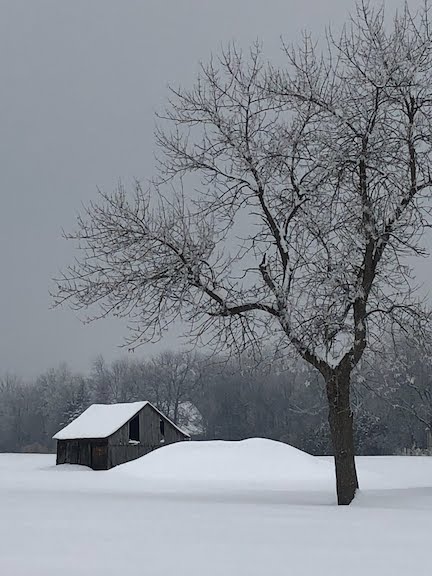
It was a moment to be reminded of the very special character of the winter landscape, and the singular appeal of familiar places.


 |
| Contemplation, Pascale Girardin |
"The all-white installation with gilded accents of 24-karat gold is made up of over ninety floral suspensions ranging from thirty centimetres to one meter in diameter, made of lightweight aluminum. These garlands cascade through the atrium from the seventeenth to the eighth floor, evoking the cycles of nature—the blossoms of spring flowers, the movement of petals adrift on a summer breeze, the spill of autumnal leaves and the lightness of falling snow."The original, site-specific sculpture, titled Contemplation,
"spans nine floors and is 31.5 m high. A multitude of floral rosaries, made up of nearly a hundred flowers and petals, cascade down between the seventeenth and eighth floors. Manufacturing and installation took about nine months. The meticulous installation of each petal and flower was... carried out over a period of three weeks."We inquired of the hotel doorman about the possibility of seeing the sculpture when we realized it was not immediately visible on entering the hotel. We were referred to the front desk, and then assigned to a gracious hotel staffer, who escorted us to the 8th floor, where we had a good view of the atrium, ascending to the sky.
 |
| the entrance to the Four Seasons, on rue de la Montagne |
 |
| Rue de Buade #2 |

 |
| "Twilight Avenue", by Pascal Campion |


 |
| Even the floor serves as a screen for ever-changing imagery. |
 |
| Anni Albers, Black White Yellow, 1926 included in her retrospective show at Tate Modern, 2018-19 |
"Craft is also a rich tapestry of ethnic diversity, having been practiced expertly by people of all nations and regions for millennia. You can make a strong case that the long-standing marginalization of the crafts—and the self-evidently crazy idea that painting isn’t one—was just the art world’s way of practicing sexism and racism, barely disguised as a policing of disciplines rather than people."
 |
| an installation photo from "Taking a Thread for a Walk", a show organized for the re-opening of MOMA, and continuing until April 19, 2020 |
"At a time when our collective attention is dangerously adrift, trapped in the freefall of our social-media feeds and snared in a pit of fake facts, handwork provides a firm anchor. It cannot be spun. It gives us something to believe in."I expect to visit the MOMA show before it closes, and will share the experience by posting here.
 |
 |
| John Fretz, Felicity, stoneware, glazes |
 |
| Mana Hamami, The Mathematician, ink jet on acrylic |
 |
| I was pleased to show a mix of fibre and paintings. |
 |
| A piece in hand-dyed linen, seen on left, is hung on the wall furthest from the entrance, and its stark brightness helps to draw in visitors. |
 |
| It was busy at the vernissage. |
Heather Dubreuil presents both semi-realistic and abstract textile art. In Cityscapes the artist transforms her own photographs of everyday urban scenes into elegant compositions of shape, line and expressive colour. Her most recent series features hand-dyed linen works pieced together and delicately detailed with corded threads, machine stitching and hand embroidery. Their square format and size – 24 x 24 inches - result in poised colour fields reminiscent of the pioneering masters of minimalist abstraction. Dubreuil’s works, however, carry the feel of textile; their textural surface, warm colour palette and hand embroidery lending them a sensuous, haptic appeal. Best known for her work in cloth and stitch, Heather also explores abstract imagery with acrylic paint and collage, some of which are included in the exhibition. Dubreuil received a BFA from Concordia University. She has shown in many solo and group exhibitions and her works appear in collections in Canada, the U.S. and Europe. She has also been profiled in several books and magazines.The show continues until February 16, 2020. A drop-in event with the artists is scheduled for Tuesday, January 21, 2 - 3 p.m., at Victoria Hall, 4646 Sherbrooke St. West, Westmount.


"As modern art becomes for us less a train racing forward than a many-sided landscape to be explored at leisure, and for pleasure, progress becomes a less certain term."
"Impressionism is a misnamed French movement from the 1860s to the 1880s. Actualisme might have been closer to its true spirit, which was not to record a quick impression of a scene or place but to give permanent form to the ambivalent pleasures of modern life, and in a style shorn of rhetoric and the painstaking pomposity of official art. It was an art about light and life, and how each illuminates the other."
"Light and life, light as it falls and life as it is. Though truth to local colour is no longer the whole of art, it always will be the heart of painting. Any art that chooses light and life as its object and subject, whatever flag it flies, will shine. The best kind is light on life in a winter house on a snowy city evening, drawing us home, even as we stand outside to look a moment longer."
 |
| Maurice Cullen, Winter Night, Craig Street, Montreal, 1899 |
 |
| Paul Signac, Juan les Pins. The Evening, 1914 |
"Discover a magnificent body of 500 paintings and graphic works from an exceptional private collection to be exhibited in its entirety for the first time – the largest collection of works by Paul Signac, but also of avant-garde: Impressionists (Monet and Morisot), Fauves (Dufy, Friesz and Marquet), Symbolists (Gauguin, Mucha and Redon), Nabis (Bonnard, Denis, Lacombe, Sérusier, Ranson and Vallotton), Neo-Impressionists (Cross, Guillaumin, Luce, Pissarro, Seurat and Van Rysselberghe) and observers of life in Paris (Anquetin, Degas, Lautrec, Picasso and Steinlen).For more information, visit https://www.mbam.qc.ca/en/exhibitions/upcoming/paris-1900/.