Monday, July 20, 2020

Sketchbook Explorations, Part 5

Continuing with the downloaded instruction from Jane Davies, I embarked on Lesson 4 of Sketchbook Practice.

We began by making large gestural paintings, on cheap 18" x 24" paper, using only black and white materials: paint, ink, crayon, marker, pencil, charcoal, etc. I spattered paint with a toothbrush, improvised paintbrushes from combs and sticks, dripped and drizzled. The idea was to ignore composition. Later, we would be selecting "interesting areas" to cut out and develop.


Somehow, when I am told to do this kind of thing, I begin to work very fast. The result was six large, indistinguishable messes: minestrone soup.

I am so glad that I tossed these six and began again, slowing down and becoming more deliberate, more thoughtful, just as the instructor was in her demo video, creating "areas of interest."


The 8 successful candidates

This time, I had no trouble isolating eight mini-compositions to develop further, from four large sheets. One of the key things was to keep distinct areas of dark and light. After gluing them down on larger,  better-quality paper, I began to develop each one in turn, extending shapes, adding shape and line. And I have another eight mini's that are also candidates as "starts".

The 8 runners-up

Here are some of the results. I don't see any of these as finished pieces, but rather exercises in composition, creating variety and interesting shapes and lines.


To prepare for Lesson 5, we were asked to paint a random shape/line with black paint on small (7" x 7") squares, and then to augment that with a "wash" of black paint. These will be developed later.


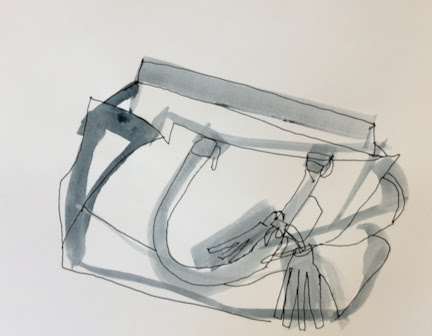
The final part of Lesson 4 was to make a rough contour drawing of an object, using a black wash and a big brush. As a second layer, we were to do a quick contour drawing of the same object on top of the wash study, either aligning the two studies or offsetting them.

I was unhappy with my first efforts. There was no energy to them. They were more like drawings that had been filled in with wash, like a child's colouring within the lines.


Blah

So I took a looser approach and repeated the exercise, disregarding the matching of the two sketches and going for something of an offset effect.


more lively, more interesting

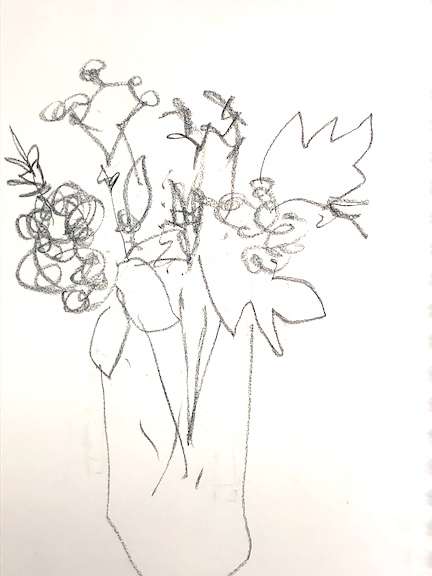
Could still stand to loosen up a bit more. Perhaps a floral arrangement, a more organic subject?

I'm beginning to see how having a regular sketchbook practice would be a good way to generate ideas for further development.

Wednesday, July 15, 2020

Sketchbook Explorations, Part 4


The opening exercises in Lesson 3 of Jane Davies' on-line workshop focus on shape and line together.


We began by applying water to paper, and then adding drops of ink to create random shapes. We could manipulate these shapes by tilting the paper, allowing the ink to run amok. We could lighten the results by applying a paper towel to areas where the ink had pooled, lifting some of the ink. I also spritzed water onto the paper, to encourage more randomness in the results.


Once these papers had dried, we added line, using a variety of materials (graphite pencil, charcoal, paint marker, conté crayon). Sometimes the line might outline the shape; at other times it might ignore the shape. It could be a languid line or one full of energy, scribbled or precise, confident or hesitant. The lines could be separate from each other, or echo each other, or intersect.


I think the whole exercise is about honing our observational skills (how does this line relate to this shape?) as well as encouraging a variety of line.


Our next assignment began by laying down a wash of colour to make some backgrounds.  (We had the option of using an unpainted background.) Then, we used paint to make a solid shape of any size. Next, we added a collage shape, and finally we added a third shape, using only its outline.


Some of the shapes could extend beyond the edge of the paper. Shapes could touch each other, or overlap each other, or remain separate.


We were to notice the edges of the shapes: were they soft, or brushy, or hard? Cut or torn?


Also to be noticed: rectilinear shapes vs. curving shapes...


... relative size of the shapes...


... alignment of shapes...


... busy areas vs. quieter areas...


... shapes inside shapes.


Again, these are exercises in observation, and noting all the ways of achieving variety. Even with the constraints, I'm beginning to think about composition. What do I find interesting? Why?

Continuing along with the line/shape dynamic, we made mini-compositions that conformed to our own parameters. For example, I chose to work with two shapes and one line.


It's not always clear to me whether a line functions as a line or as the outline of a shape.

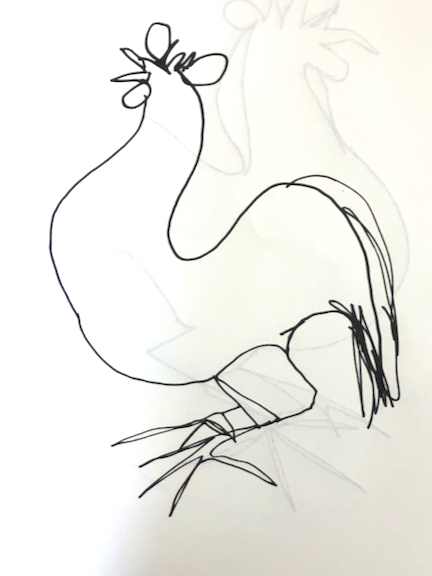
Next, we were to return to some timed contour drawing that we had made in a previous exercise, and add "something" to them. Shown below are the original 60-second drawings, and the "something extra" added to them.


The teapot was painted white and a multi-coloured wash
was added to the background. (Paper wrinkled.)


Collage and watercolour were added.


This drawing has the same subject as
the one above, but was done with conté crayon,
and was left "unimproved."


The still-life sketch above was transformed
with the addition of oil pastel.


Collage and paint were added to the sketch.


Watercolour was added.

The final exercise of this Lesson 3 was to use black paint to draw the negative space in a still-life arrangement. In other words, don't outline your subject, but just go in there with your brush and paint what you discern to be the spaces between the shapes.


I like the fresh effect I can get by doing a 60-second drawing. There is often a charming, naive, and lively quality to a timed drawing.

Sunday, July 12, 2020

Malcolm Gladwell's podcast series


A friend recently steered me to "Revisionist History", a podcast series from Malcolm Gladwell. As I am a fan of Gladwell's books, I was interested to access his thought-provoking ideas in another format.

I was especially intrigued by Episode 1 of Season 5, titled "Dragon Psychology 101", in which Gladwell examines the whole rationale of art museums. He makes the point that so often museums are judged on the size of their collections, and their directors are judged by how much the collection expands during their tenures.

Gladwell questions whether the high cost of maintaining and storing millions of artifacts is justified, especially if the collections are so vast that most of the holdings will never see the light of day. Perhaps government money and charitable giving would be better directed elsewhere?

Episode 2 of Season 5, "Hedwig's Lost Van Gogh", explores the dilemma of museum collections further, with a focus on deaccession and restitution. Much food for thought here.


Wednesday, July 8, 2020

Paris in the Days of Post-Impressionism @ MMFA

The Port of Marseille, Albert Marquet, 1916, oil on canvas


More than 500 paintings, drawings, prints and posters have been assembled for this summer's blockbuster show at the Montreal Museum of Fine Arts. Amazingly, the works belong to a single private collector, who remains anonymous.


The Flowering Tree, Achille Laugé, 1893, oil on canvas

I was thrilled to visit the show on its opening day, but I plan to return soon, taking the opportunity to listen to the detailed audioguide, available free on the museum's app.


View of London, Maximilien Luce, 1893, oil on canvas


Many of the artists represented will be familiar to the casual visitor (Monet, Degas, Pissarro, Lautrec, Morisot) but other names will be new to many of us. The informative text posted alongside the works outlines some of the artistic and social issues faced by the artists of the time.


Saint-Tropez, Fontaine des Lices, Paul Signac, 1895, oil on canvas


The exhibition continues until November 15, 2020. To manage the number of people in the gallery, visitors are required to book timed tickets, either on-line or by phone.


Cruiser Decked with Flags in Antwerp, Othon Friesz, 1906, oil on canvas

Sunday, July 5, 2020

Preview of upcoming auction at Heffel

Once again, Heffel will hold a live auction of fine art at its Toronto location. The Post-War and Contemporary Art will be auctioned on July 15, 2020, at 5 pm, and the Canadian, Impressionist and Modern Art will be auctioned later that day, at 7 pm.

Most of the items to be auctioned were on display at the Montreal branch of Heffel for the past three days, and I was lucky enough to catch the event. The preview has not been well-publicized, as the venue is not suitable for large crowds during this pandemic.
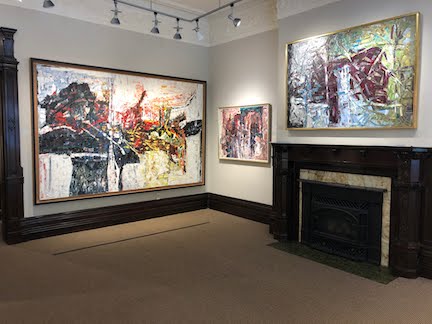
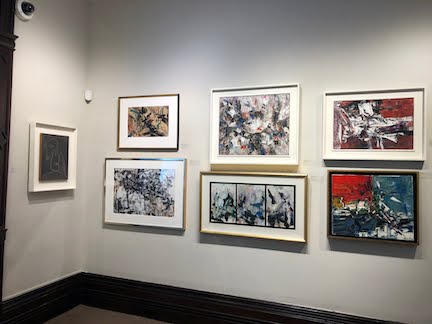
The Heffel Gallery in Montreal is located in a fine old mansion on Sherbrooke Street. Below are some interior shots of the preview. Sadly, they fail to capture the dazzling quality of the works on view, or the grandeur of the setting. Artists include Christopher Pratt, Alex Colville, Jean Paul Lemieux, Joan Mitchell, Emily Carr and Jean Paul Riopelle. Also represented are most members of the Group of Seven.


.


The Heffel website includes photos of all the works to be auctioned. By clicking on any image, you can access a close-up, as well as biographical information about the artist, the provenance of the painting, and the price it is expected to sell for at the auction.