Showing posts with label finds. Show all posts

Wednesday, February 3, 2021

A Close Read of a Cubist Masterpiece


The New York Times publishes an occasional series of "close reads" of iconic works of art. Most recently, "Still Life with Table", by Juan Gris, was chosen as a subject for exploration.

If asked to name the most revolutionary new artistic medium in 20th-century art, would you choose Cinema? Video? Installation? Writer Jason Farago suggests it might well be Collage. Readers learn about the impact of collage as a medium, and what the use of glued newspaper had to say about the explosive influence of journalism on French café society.

What is real and what is false? Wood-grained paper purports to represent a wooden surface. And the content of these same newspapers: true or false?

Farago refers us to the impact of African sculpture, with its shattering portrayal of three-dimensional space, so different from the classic perspective of European traditionalists. The painted landscapes of Cezanne are cited as an earlier challenge to the accepted view of reality.

The fascinating analysis, with its many supporting illustrations and close-up views, is well worth a look.


Wednesday, January 6, 2021

Architecture and Knitting Machines


I subscribe to a blog by painter James Gurney, where I recently learned about an innovative approach to building that relies on knitted textiles to support concrete construction. This method is being explored as a new way to build affordable housing, with a smaller environmental footprint.

The video below features architect Mariana Popescu, explaining how knitting machines can create the "bones" of concrete structures.


Sunday, December 27, 2020

Hidden Pond Yarns


Many of us are especially focused on family at this time of year.  So please indulge me when I explain how very proud I am of my daughter, Katya. The busy mom of two little ones, Katya has long had an interest in knitting and a great eye for colour. When the pandemic began, she took the opportunity to open a home-based business, offering hand-dyed yarn. Hidden Pond Yarns is getting 5-star reviews!


Katya's gorgeous yarns are available through her Etsy site. Their rich colours have even re-kindled my own long-dormant interest in knitting.

Wednesday, December 23, 2020

Another project for Christmas giving

without hat

I discovered this charming doll pattern on line, and just had to knit it up for my granddaughter. A steep learning curve for me, but I persisted. I love her unruly hair. My daughter chose the colour palette and supplied me with her own hand-dyed yarn.


with hat

The pattern is available on-line from Mary Jane's Tearoom, along with knitting patterns for delightful teddies, elephants, rabbits and mice. The patterns are also carried by Ravelry and Etsy (just do a search for "Mary Jane's Tearoom".)

Sunday, September 27, 2020

"Close Reading", a mini-lesson in art history

The New York Times presents a compelling look at this self-portrait by Albrecht Dürer, and explains the significance of self-portraiture, as it emerged in the early Renaissance. Find it here.

Wednesday, September 2, 2020

Storm King sculpture park


In the August 31, 2020 issue of the New Yorker, Peter Schjeldahl, the magazine's art critic, writes about the Storm King sculpture park, located just north of New York City. 

About a year ago, I was lucky enough to visit the park myself, and blogged about the visit here.

Because of social distancing, the park is admitting only 300 visitors each day, using a timed ticket system. The venue will be open until December of this year.

While it is always inspiring to view art in a natural setting, Schjeldahl observes that these days, with our opportunities to look at art so limited, Storm King offers something very special indeed.

Sunday, August 23, 2020

Sophie Taeuber-Arp

Quadrangular Spot Composition, gouache on paper, 1920


Here's an item lifted directly from The New Yorker, August 3 & 10 edition:

Sophie Taeuber-Arp 

Recent reconfigurations of modern art history are finally bringing the essential contributions of women artists into the light. Although certain figures – such as the Swedish painter Hilma af Klint – did work outside of established avant-garde circles, other pathbreakers, such as Taeuber-Arp, have been hidden in plain sight. The Swiss polymath's marriage to her fellow Dadaist Hans Arp may have secured her initial entry to that fervid scene, but her collaborative spirit – she worked with Arp, among other male artists – likely denied her top billing until now. An online viewing room, on Hauser & Wirth's Web site, celebrates the gallery's representation of Taeuber-Arp's estate with images of her dynamic Constructivist tapestries and paintings, geometric costumes and marionettes designed for performances at Zurich's legendary Cabaret Voltaire night club, sinuous carved sculptures, and more. A brief documentary overview of her career offers memorable glimpses of the artist's interior-design work, including the painted walls of Strasbourg's Café de l'Aubette and a Bauhaus-inspired studio-residence outside Paris, where she gathered with friends (Sonia and Robert Delaunay, Joan Miró, and Marcel Duchamp among them). Next year's Taeuber-Arp retrospective, co-organized by MOMA, the Kunstmuseum Basel, and the Tate Modern, can't arrive soon enough.

Go to https://www.hauserwirth.com/artists/27538-sophie-taeuber-arp to learn more.


Wednesday, August 5, 2020

Rag doll project


Here's a link to a free pattern for a rag doll. It's a fun way to use up scraps of cloth and yarn, and a lot of the stitching and stuffing can be done while watching TV. 

The finished doll measures 15" tall and took me about 4 hours to make. The faces were painted on with fabric markers, though embroidery is another option.

The doll pattern comes from Toronto designer Amie Scott. Amie sells retro-style cotton dresses and sewing patterns on her Etsy site.

Sunday, July 12, 2020

Malcolm Gladwell's podcast series


A friend recently steered me to "Revisionist History", a podcast series from Malcolm Gladwell. As I am a fan of Gladwell's books, I was interested to access his thought-provoking ideas in another format.

I was especially intrigued by Episode 1 of Season 5, titled "Dragon Psychology 101", in which Gladwell examines the whole rationale of art museums. He makes the point that so often museums are judged on the size of their collections, and their directors are judged by how much the collection expands during their tenures.

Gladwell questions whether the high cost of maintaining and storing millions of artifacts is justified, especially if the collections are so vast that most of the holdings will never see the light of day. Perhaps government money and charitable giving would be better directed elsewhere?

Episode 2 of Season 5, "Hedwig's Lost Van Gogh", explores the dilemma of museum collections further, with a focus on deaccession and restitution. Much food for thought here.


Sunday, May 31, 2020

Félix Fenéon @ MOMA


As part of their "Virtual Views" series, New York's Museum of Modern Art offers this 4-minute video, profiling Félix Fenéon, "an extraordinarily influential but little-known figure".

Anarchist, civil servant, art critic, publisher, dealer and collector, Fenéon "shaped the development of modernism". He is credited with coining the term "Neo-Impressionism", and championed artists like Georges-Pierre Seurat, Paul Signac, Pierre Bonnard, Henri Matisse, and Amedeo Modigliani.

To learn more about Fenéon, visit the MOMA website.

Sunday, May 24, 2020

Michael West, Abstract Expressionist, 1908-1991


Michael West in her apartment, c. 1977

I was intrigued to read about the female abstract expressionist, Michael (Corinne) West, on Artsy.net. Little-known, her work and career have recently attracted renewed interest.


Michael (Corinne) West, Blue Figure, 1948

West died in 1991, with no heirs or even a will. The contents of her Upper West-Side apartment were auctioned by the City of New York. Stuart Friedman, an art photographer who had bought one of her paintings in a thrift shop a few years earlier, was the only bidder. Using his garage to store the many canvases he found in her apartment, he began to learn more about her, and to promote her work.

The Hollis Taggart Gallery in New York bought the whole lot last year, and staged a show of her work.


Michael West at Granite Galleries, 1963

an installation shot of "Space Poetry: the Action Paintings of Michael West",
Hollis Taggart Gallery, 2019

A student of Hans Hoffman, West had a number of gallery shows in New York in her lifetime. It is thought her lack of worldly success was, in part, due to her lack of interest in "networking".

You can read more about Michael West in the Artsy article, written by Karen Chernick. An on-line exhibition of her work, titled "We Come Alive and Dream", is also available.


Michael West, Stonington, Connecticut, c. 1955

Sunday, February 16, 2020

The Forgotten Female Art Dealer Who Championed Picasso and Modigliani

An article on Artsy, written by Karen Chernick, has introduced me to an intriguing personality. Her name was Berthe Weill, and I had never heard of her.

In 1901, at the age of 36, the Parisienne Berthe Weill opened an art gallery where she sold the work of emerging artists at modest prices. Writes Chernick,
"Weill bought, exhibited and sold Pablo Picasso's work before he ever moved to Paris or painted any of the works for which he's now considered a modernist legend.... She sold his Moulin de la Galette (c. 1900) for 250 francs to collector and newspaper publisher Arthur Huc.
"Huc made another purchase from Weill that year, a still life by Henri Matisse, for the bargain rate of 130 francs, the first ever sale by a dealer for the young Fauve artist."

Moulin de la Galette, Pablo Picasso, now in the Guggenheim Museum

Among the artists she championed during her 40-year career were André Derain, Georges Braque, Aristide Maillol, Kees van Dongen, Maurice de Vlaminck, Suzanne Valadon, Maurice Utrilllo, Georges Roualt, Raoul Dufy, Robert Delauney and Amadeo Modigliani. Midway through her career she began to dedicate half of her exhibitions to women artists. As the artists became more recognized, they moved on to better-known galleries, and Weill never achieved much financial success.


Portrait de Berthe Weill, Georges Kars, 1933

Sadly, Weill had to close her gallery in 1941. As tough as she was, life had become too difficult for a Jewish businesswoman in German-occupied France. Ten years later, she died in poverty.

There is a local connection to this story: in 2022, the Montreal Museum of Fine Art will stage a show of some 80 paintings that passed through her gallery.

Wednesday, February 12, 2020

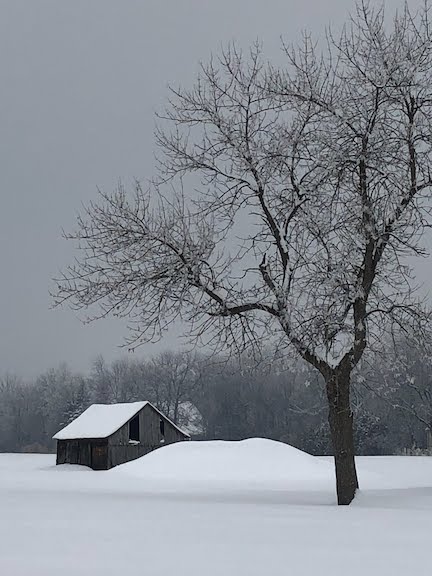
After the storm...

... I took these photos on my iPhone, driving home from Costco.

It was a moment to be reminded of the very special character of the winter landscape, and the singular appeal of familiar places.


Sunday, February 9, 2020

Installation at Montreal's new Four Seasons hotel

When I read the article in Westmount Magazine, I knew I had to visit the sculpture that forms the centrepiece of this newly-updated Montreal hotel.


Contemplation, Pascale Girardin

Pascale Girardin, a Montreal artist, has created a breathtaking installation that plays beautifully on the name of the prestigious hotel on Rue de la Montagne. 
"The all-white installation with gilded accents of 24-karat gold is made up of over ninety floral suspensions ranging from thirty centimetres to one meter in diameter, made of lightweight aluminum. These garlands cascade through the atrium from the seventeenth to the eighth floor, evoking the cycles of nature—the blossoms of spring flowers, the movement of petals adrift on a summer breeze, the spill of autumnal leaves and the lightness of falling snow."
The original, site-specific sculpture, titled Contemplation,
"spans nine floors and is 31.5 m high. A multitude of floral rosaries, made up of nearly a hundred flowers and petals, cascade down between the seventeenth and eighth floors. Manufacturing and installation took about nine months. The meticulous installation of each petal and flower was... carried out over a period of three weeks."
We inquired of the hotel doorman about the possibility of seeing the sculpture when we realized it was not immediately visible on entering the hotel. We were referred to the front desk, and then assigned to a gracious hotel staffer, who escorted us to the 8th floor, where we had a good view of the atrium, ascending to the sky.

We were told that lighting is used to create various colour effects on the blossoms. At the time of our visit, some of the aluminum petals had a suggestion of pink reflected light, giving the impression of floating cherry blossoms.

The organic forms of the petals are a lyrical contrast to the grid-like structures of the building's architecture.

Note: A friend who was inspired to visit the installation was told that it is only available to hotel guests. :-(


the entrance to the Four Seasons, on rue de la Montagne

Wednesday, January 22, 2020

Why the Art World is Embracing Craft: Artsy

Thank you to Michele for bringing this recent Artsy post to my attention. Readers should be able to access it here.

The author, Glenn Adamson, celebrates a renewed interest in craft as art, evidenced by several major museum shows and by rising sale prices for craft-based art.

Anni Albers, Black White Yellow, 1926
included in her retrospective show at Tate Modern, 2018-19

He proposes that bringing craft "into the circle" is a way of ensuring the inclusion of women and non-Western artists.
"Craft is also a rich tapestry of ethnic diversity, having been practiced expertly by people of all nations and regions for millennia. You can make a strong case that the long-standing marginalization of the crafts—and the self-evidently crazy idea that painting isn’t one—was just the art world’s way of practicing sexism and racism, barely disguised as a policing of disciplines rather than people."

an installation photo from "Taking a Thread for a Walk",
a show organized for the re-opening of MOMA, and continuing until April 19, 2020

He also suggests that the embrace of handwork reflects our hunger for "materiality" in an increasingly virtual world.
"At a time when our collective attention is dangerously adrift, trapped in the freefall of our social-media feeds and snared in a pit of fake facts, handwork provides a firm anchor. It cannot be spun. It gives us something to believe in."
I expect to visit the MOMA show before it closes, and will share the experience by posting here.

Wednesday, October 9, 2019

The Frelinghuysen Morris House & Studio

A recent holiday in New England included tours of historic homes, including Hildene House in Manchester, Vermont, home of Robert Lincoln, son of Abraham Lincoln. A memorable part of these tours was the opportunity to walk through forested pathways on the house grounds.

Acres of woodland at The Mount, Edith Wharton's home in Lenox,
are carpeted with periwinkle. In the spring,
when it's blooming with blue flowers, it must be a thrilling sight.

This was our experience as we approached the Frelinghuysen Morris house and studio for our guided tour. I have to ask you to imagine the sensation of the crunchy mulch underfoot, the gentle breeze that rustled the leaves, the fragrance of autumnal decay, the dappled sunlight and the hum of the cicadas. The 46-acre estate also includes a formal garden and a small pond.


The studio space was inspired by Fernand Léger's studio
 in France, as designed by Le Corbusier

George L.K. Morris grew up on these grounds in Lenox, Massachusetts. As a young man from a wealthy family, he pursued an interest in art and was hired by MOMA to travel to Europe and buy work for their collection. He was friendly with the French painter Fernand Léger and others. In the early '30s, he had this studio built for himself on the grounds of the family estate. Around this time he married Suzy Frelinghuysen, an accomplished opera singer and visual artist, and together they enjoyed a privileged life, much of it spent in Europe.  Their own art collection included paintings and sculpture by Léger, Picasso, Miro and Gris, among others.


Entrance hall to house, with Morris's fresco

Within a few years a house was added to the studio, designed by the couple and meant to be a part-time residence. Morris himself painted the frescoes.


The living room, with its original furnishings.
The floor has recently been replaced with new leather tiles, as per the original.
Note Morris' fresco on the wall at right.

The light-filled studio

The visit included a one-hour video documentary on the lives of the couple, and a one-hour tour with a very knowledgeable guide. Go to this link for more information about the Frelinghuysen Morris House and Studio.

Saturday, September 14, 2019

Artch: Emerging artists show @ Dominion Square

This weekend, Artch offers a juried, outdoor exhibition of 23 artists, all 35 and under, in Montreal's Dominion Square.


A few of the artists work in fibre, and I was especially taken with the work of Florence Giroux Gravel. She uses coloured thread, stretched with high tension between opposite sides of a frame, to create interesting effects. As the viewer moves, the threads seem to shimmer and shift in colour.


close-up detail of work above

Gravel also has some small compositions
in coloured thread,
stitched into a heavy paper background

I was reminded of the larger, more complex work by Gabriel Dawe that I saw a few years ago at the Renwick Gallery, part of the Smithsonian in Washington D.C.


Gabriel Dawe, Wonder, 2017

I was also reminded of the way Sheila Hicks makes beautifully-textured work by wrapping yarn around stretcher bars.


Sheila Hicks, Grass Pathway to Work, 2018
linen, wood; 32 1/8 x 51 1/8 in.

Gravel will have a show at the AVE Gallery, 901 rue Lenoir, Montreal, October 24 - November 27, 2019.

Sunday, July 7, 2019

Whammock!


Here's an item I learned about through my subscription to the Fiber Art Network, which recently posted this link about an art installation in the New Children's Museum of San Diego.

"The stunningly colourful 28 by 20-foot, three-dimensional textile structure resembles a giant hammock of crocheted circles, open pockets and hanging pendulums. Within this play-structure, children are able to move upwards through one pocket after another until they reach a vibrant expanse where they can climb, slide, bounce and rest. It’s a one-of-a-kind place to play and interact with others, and the first large-scale work at a museum in the U.S. by internationally renowned textile artist Toshiko Horiuchi MacAdam."


By the numbers:
  • 3600 hours of crochet
  • 40 miles of hand-braided nylon
  • 1000 pounds of net
  • 14 hand-dyed colours
  • will be in place for at least 5 years.
To quote McAdam, who works out of Bridgetown, Nova Scotia,
"To me, the concept of Whammock! is to connect with others through the waves of vibration in the net.... If a child climbs, jumps or crawls in one place then another child will feel the vibration and respond with their action, and in this way, they are naturally communicating to one another.” She also explains that the name Whammock! comes from the word hammock. “Every culture has a hammock or type of cradle, and Whammock! is a giant one that impacts everyone who plays in it.”
Here's a time-lapse video of Whammock's installation. Enjoy!


Wednesday, March 6, 2019

"Wall of Art", McLennan Library, McGill University


Had a fun visit to see a hidden treasure on the 4th floor of McGill's McLennan Library.


To quote from the display panel:
"Most museums have 2-3 % of their collection on view at any given time, holding the rest in storage. McGill's Visual Arts Collection is an exception, displaying the majority of its holdings in over 90 buildings and outdoor spaces on several campuses. Our new Visible Storage space presents a selection of those works that are nevertheless in storage, offering visitors increased access to the Collection.
"Visible Storage has become a popular practice in institutions worldwide. These spaces reproduce the environmental and control conditions of storage facilities in open-access areas, allowing the display of works that are particularly sensitive, or that would simply not otherwise be seen on a regular basis. Works are on view 'salon style', stacked to maximize space, as they would be in storage.
"Made possible by the McGill Library Innovation Fund, this Visible Storage gallery will be in progressive installation over the summer, during which it will remain open to visitors. The works on view will together represent a cross-section of our holdings in Canadian, Indigenous, and international art, both historical and contemporary." 

Edwin Holgate, Woman Before a Window, 1960

Works from 24 artists were on view during my visit, including paintings by well-known Canadians Moe Reinblatt, Betty Goodwin, Sylvia Safdie, Marc-Aurèle de Foy Suzor-Coté, Yves Gaucher and Rita Letendre.


Lilias Torrance-Newton, Portrait of H. Rocke Robertson, 1971

Norval Morrisseau, Shaman Surrounded by Ancestral Spirit Totem, 1997

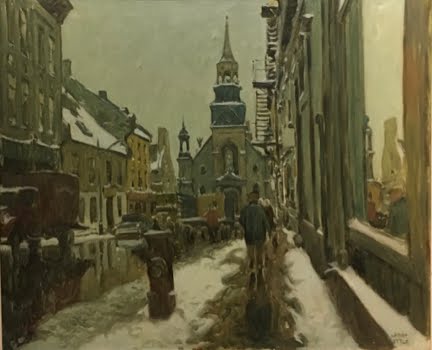
John Little, Bonsecours Church

If you have a chance to visit, be sure to stop in to see the exhibit of antique "pop-up" books in the rare books section of the library and, in the lobby, the display of antique medical books on the topic of Conception.

Wednesday, February 13, 2019

Ten free on-line courses to help jumpstart your creativity

References, Anna Valdez, 2014

Perhaps this is just the tonic needed as we struggle through a very long winter.

Thank you to SAQA (Studio Art Quilt Associates) and its Fiber Art Friday newsletter for passing along the link to this resource.