Showing posts with label museum. Show all posts

Sunday, March 28, 2021

Des Horizons d'Attente @ MAC Montréal

The Musée d'Art Contemporaine is currently staging a show of its recent acquisitions. Des Horizons d'Attente features the work of 21 Montreal-based artists. There are no traditional paintings in the collection. Instead, visitors are treated to some novel uses of materials like cloth, paper, wood and plastic. There is a particular emphasis on aboriginal issues and imagery.

Facade de recueillement, 2016-2017
[Contemplation Facade]
Myriam Dion
Japanese paper cut with X-acto knife, graphite

Facade de recueillement, 2016-2017
[Contemplation Facade]
Myriam Dion
Japanese paper cut with X-acto knife, graphite

"Myriam Dion pushes the fragility of paper to its limits by means of an infinitely meticulous precision knife (X-acto).... The delicate, slow, calm and solitary process required to produce this lace-like work represents the materialization of the artist's musing on the Syrian conflict and the migrant crisis rocking the planet. The installation Facade de recueillement takes up the architectural motifs of the façade of the Great Mosque of Aleppo, which was destroyed by the bombing...."

Essai d'aplanissement entre les mondes, 1999-2020
[Levelling Trial Between the Worlds]
Pierre Bourgault
Installation: shore mud on wood and ink-jet print on paper

Essai d'aplanissement entre les mondes, (detail) 1999-2020 
[Levelling Trial Between the Worlds]
Pierre Bourgault
Installation: shore mud on wood and ink-jet print on paper


water song [Kinosipi] 2019
Hannah Claus
Installation, digital print on Jetview© film,
thread, PVA glue, acrylic

water song [Kinosipi] 2019 (detail)
Hannah Claus
Installation, digital print on Jetview© film,
thread, PVA glue, acrylic

"water song [Kinosipi] is based on the sound spectrum of a song by Atikamekw singer and storyteller Karine Wasiana Echaquan."

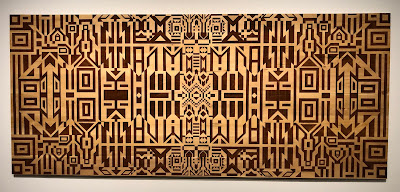
Lot #X - Front de la rivière Désert, 2018
[Lot #X - Desert River Front]
Caroline Monnet
Pyrography on wood

"Using pyrography, a network of geometric motifs inspired by Indigenous graphic traditions is outlined on this large wooden support made of white cedar..., a tree native to Canada and considered sacred by First Nations. The mention of the term 'Lot # X' in the title, the horizontal cuts and the arrow symbols in the composition suggest the lots of land laid out following the forced uprooting of Indigenous communities over the centuries. Like a metaphorical map with a modern pictorial look, this work gives material form, through wood burning, to the confiscation of Indigenous lands and the scars it has left on Indigenous peoples".

The exhibition continues until September 19, 2021.

Sunday, March 21, 2021

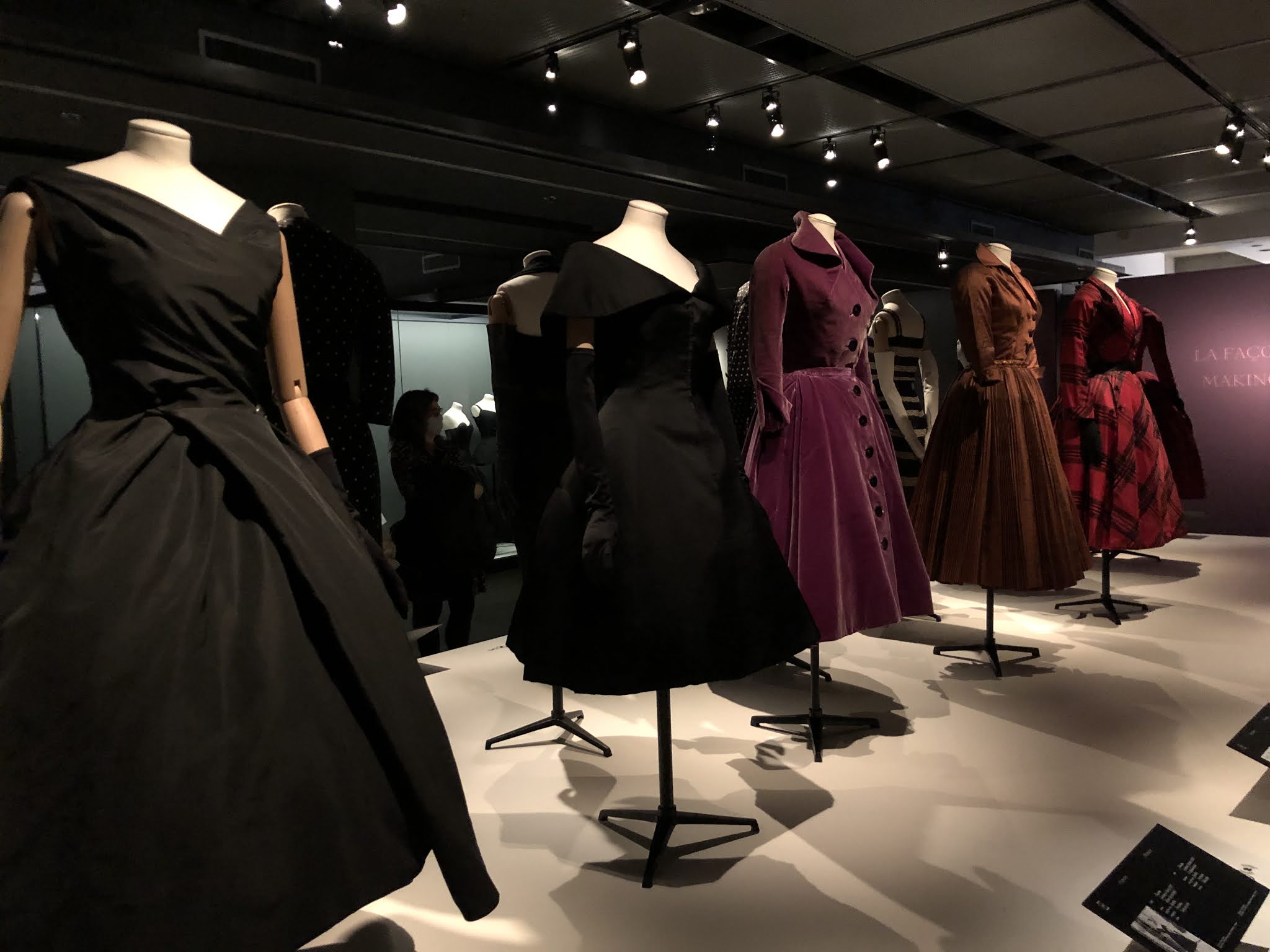
Christian Dior @ the McCord

Until May 2, Montreal's McCord Museum will host a tribute to Christian Dior. Fans of fashion and of the textile arts will find much of interest. 

silks and velvets in abundance

We learn about the appetite for high fashion after World War II. Dior is quoted as saying that, after wartime austerity, "women wanted to feel like women again". He achieved a sense of opulence with his extravagant use of fine fabrics. Wartime skirts and suits were cut so as to use a minimal amount of cloth; post-war, Dior embraced pleats to achieve a lavish amount of fabric.


We trace the process of couture, from an original idea to a mock-up in muslin, to realization in the hands of needleworkers.

beads, sequins, and threads

Impressive samples of embroidery and beading are on display.

Videos give visitors a taste of the in-house fashion show. Tall, thin, wasp-waisted, the models seem like creatures from an entirely different world. I had not realized that wearing many of these structured dresses required a "dresser" to fasten all the hooks and eyes.

One wonders about the parallels between post-war fashion and post-pandemic fashion. Will we be ready to give up our "athleisure wear" and sneakers for something more structured, more formal? It will be interesting to see how the fashion industry tries to create an appetite for something new and different.


The number of visitors to the museum is controlled with time-specific tickets. Phone the McCord or go to their website. Admission to non-members is free on the first Sunday of the month.

Wednesday, March 17, 2021

Fibre Art Exhibition at the Smithsonian

The Smithsonian Museum of American Art has organized Subversive, Skilled, Sublime: FibertArt by Women, originally scheduled for April 22 - August 28, 2022. At this time the museum is closed, and opening dates are to be announced.

The website reads, in part:

"The thirty-four selected artworks piece together an alternative history of American art. Accessible and familiar, fiber handicrafts have long provided a source of inspiration for women. Their ingenuity with cloth, threads, and yarn was dismissed by many art critics as menial labor. The artists in this exhibition took up fiber to complicate this historic marginalization and also revolutionize its import to contemporary art. They drew on personal experiences, particularly their vantage points as women, and intergenerational skills to transform humble threads into resonant and intricate artworks."

Visitors to their website can see the thirty-four works selected for the show. Artists include Sheila Hicks and Judith Scott, whose work I have profiled here in the past.

Sunday, January 31, 2021

What's Happening at the Louvre?


Never since World War II has the Louvre been closed for such a long time, but during the pandemic, the Louvre is still a hive of activity. With no visitors permitted, the museum is undergoing a major "refresh". I read about it in the New York Times. Lots of great photos help to give a sense of what's going on.

Sunday, January 3, 2021

Excellence in Fibers VI

Repair (detail), Kevan Lunney, 2016
Aluminum base, neon glass tubes, industrial wool felt,
white electric cord; back fully enclosed with
removable aluminum plate, knitted construction

This virtual show is presented by the New Bedford Art Museum, in Massachusetts. It showcases fifty-two outstanding works, juried from over 1100 submissions, in the categories of 

  • Installation
  • Sculptural
  • Vessels
  • Wall and Floor, and
  • Wearables.
The exhibition presents a truly astonishing diversity of material, technique, and subject.

Wednesday, December 30, 2020

The Queen and The Crown @ the Brooklyn Museum

Those who have enjoyed the Netflix series of The Crown, Season 4, and The Queen's Gambit, may wish to know more about the costumes. Currently, the Brooklyn Museum is staging a virtual show that allows visitors to see many of the costumes made for these productions, to view them in detail, and to access more information from the costume designers themselves.

To learn more, go to the exhibition website, which offers a link to a virtual exploration of the show. The link includes film clips featuring the various costumes, and a panel discussion with the designers.

I learned about this exhibition by reading Leanne Delap's article in a recent issue of The Kit, available here.

Sunday, December 20, 2020

Quilt as Political Statement

AIDS Memorial Quilt panel, NAMES Project

This recent article in The Observer, by Karen Chernick, traces the history of quilts as political statement.

In Quilting as a Radical Act: An Exhibition Examines the Art Form's Revolutionary Impact, Chernick reviews a new exhibition at the Toledo Museum of Art, titled Radical Tradition: American Quilts and Social Change. 

While the common public perception of quilts and quilters is one of cozy domesticity, the reality is often different. This show gathers together over 30 quilts from the mid-19th century onward, revealing a long history of quilts made for social causes.

Quilts that comment on our current pandemic, and that pay tribute to its victims, are no doubt already in the making. 

Sunday, December 6, 2020

Riopelle at the Montreal Museum of Fine Arts: virtual show

Point de rencontre – Quintette, 1963,
the largest painting Jean-Paul Riopelle ever made,
displayed prominently at the entrance to the exhibition.
Commissioned for Toronto's Pearson airport, 
it was later gifted to France to mark the bicentennial 
of the French Revolution.

The MMFA offers us a virtual tour of its most recent exhibition, "Riopelle: The Call of Northern Landscapes and Indigenous Cultures", available at no cost until January 11. During this period, while the galleries are closed, other shows can be viewed at the same link:

  • Paris in the Days of Post-Impressionism: Signac and the Indépendents,
  • Yehouda Chaki: Mi Makir – A Search for the Missing, and
  • Manuel Mathieu: Survivance (coming soon)

Riopelle is one of my favourite Canadian painters, and I only wish he were better known, especially outside Canada.

Later in his career, Riopelle drew inspiration from Canada's aboriginal cultures, and the show fully addresses the issue of cultural appropriation.

Sunday, August 23, 2020

Sophie Taeuber-Arp

Quadrangular Spot Composition, gouache on paper, 1920


Here's an item lifted directly from The New Yorker, August 3 & 10 edition:

Sophie Taeuber-Arp 

Recent reconfigurations of modern art history are finally bringing the essential contributions of women artists into the light. Although certain figures – such as the Swedish painter Hilma af Klint – did work outside of established avant-garde circles, other pathbreakers, such as Taeuber-Arp, have been hidden in plain sight. The Swiss polymath's marriage to her fellow Dadaist Hans Arp may have secured her initial entry to that fervid scene, but her collaborative spirit – she worked with Arp, among other male artists – likely denied her top billing until now. An online viewing room, on Hauser & Wirth's Web site, celebrates the gallery's representation of Taeuber-Arp's estate with images of her dynamic Constructivist tapestries and paintings, geometric costumes and marionettes designed for performances at Zurich's legendary Cabaret Voltaire night club, sinuous carved sculptures, and more. A brief documentary overview of her career offers memorable glimpses of the artist's interior-design work, including the painted walls of Strasbourg's Café de l'Aubette and a Bauhaus-inspired studio-residence outside Paris, where she gathered with friends (Sonia and Robert Delaunay, Joan Miró, and Marcel Duchamp among them). Next year's Taeuber-Arp retrospective, co-organized by MOMA, the Kunstmuseum Basel, and the Tate Modern, can't arrive soon enough.

Go to https://www.hauserwirth.com/artists/27538-sophie-taeuber-arp to learn more.


Sunday, July 12, 2020

Malcolm Gladwell's podcast series


A friend recently steered me to "Revisionist History", a podcast series from Malcolm Gladwell. As I am a fan of Gladwell's books, I was interested to access his thought-provoking ideas in another format.

I was especially intrigued by Episode 1 of Season 5, titled "Dragon Psychology 101", in which Gladwell examines the whole rationale of art museums. He makes the point that so often museums are judged on the size of their collections, and their directors are judged by how much the collection expands during their tenures.

Gladwell questions whether the high cost of maintaining and storing millions of artifacts is justified, especially if the collections are so vast that most of the holdings will never see the light of day. Perhaps government money and charitable giving would be better directed elsewhere?

Episode 2 of Season 5, "Hedwig's Lost Van Gogh", explores the dilemma of museum collections further, with a focus on deaccession and restitution. Much food for thought here.


Wednesday, July 8, 2020

Paris in the Days of Post-Impressionism @ MMFA

The Port of Marseille, Albert Marquet, 1916, oil on canvas


More than 500 paintings, drawings, prints and posters have been assembled for this summer's blockbuster show at the Montreal Museum of Fine Arts. Amazingly, the works belong to a single private collector, who remains anonymous.


The Flowering Tree, Achille Laugé, 1893, oil on canvas

I was thrilled to visit the show on its opening day, but I plan to return soon, taking the opportunity to listen to the detailed audioguide, available free on the museum's app.


View of London, Maximilien Luce, 1893, oil on canvas


Many of the artists represented will be familiar to the casual visitor (Monet, Degas, Pissarro, Lautrec, Morisot) but other names will be new to many of us. The informative text posted alongside the works outlines some of the artistic and social issues faced by the artists of the time.


Saint-Tropez, Fontaine des Lices, Paul Signac, 1895, oil on canvas


The exhibition continues until November 15, 2020. To manage the number of people in the gallery, visitors are required to book timed tickets, either on-line or by phone.


Cruiser Decked with Flags in Antwerp, Othon Friesz, 1906, oil on canvas

Friday, June 26, 2020

Rosie Lee Tompkins, improvisational quilter


In a recent piece in the New York Times, June 25, 2020, art critic Roberta Smith celebrates the improvisational quilts of Rosie Lee Tompkins, whose work is very much a part of the African-American quilting tradition. The article, "The Radical Quilting of Rosie Lee Tompkins" is subtitled "A triumphal retrospective at the Berkeley Art Museum confirms her standing as one of the great American artists – transcending craft, challenging painting and reshaping the canon."


The article tells the story of a devoutly Christian California quilt maker, and the devoted collector, Eli Leon, whose obsession with her work resulted in a significant donation to the University of Berkeley.

The exhibition that sparked the article is currently mounted at the Berkeley Art Museum, continuing until December 20, 2020. While the museum is closed due to the pandemic, the show itself is available as a 70-minute virtual tour on the museum's website, as well as a slideshow.


The New York Times article ends:
"There are many museum exhibitions on lockdown in the United States right now. They closed in one world and will reopen in a very different one, and the relevance of “Rosie Lee Tompkins: A Retrospective” has only expanded in the hiatus. The sheer joy of her best quilts cannot be overstated. They come at us with the force and sophistication of so-called high art, but are more democratic, without any intimidation factor.
"Her work is simply further evidence of the towering African-American achievements that permeate the culture of this country. A deeper understanding and knowledge of these, especially where art is concerned, must be part of the necessary rectification and healing that America faces.
"Tompkins seems to have been an artist of singular greatness, but who knows what further revelations — including the upcoming survey of the Eli Leon Bequest — are in store. The field of improvisational quilting by African-American women is not small, but beyond the great quilters of Gee’s Bend, Ala., and a few others, their work is not widely known. Rosie Lee Tompkins’s version of what Eli Leon called “flexible patterning” may have been more extreme than anyone else’s. Or perhaps not. It would be gratifying to learn that she did not act alone."


Wednesday, June 3, 2020

An artist for the COVID-19 era?

Cape Cod Morning, Edward Hopper, 1950
In the June 8 issue of The New Yorker, Peter Schjeldahl writes about a show currently running at the Beyeler Foundation, Switzerland's premier museum of modern art, outside Basel. The show is called "Edward Hopper: A Fresh Look at Landscape".

Schjeldahl's article is titled "Apart: Edward Hopper's Solitude". The writer suggests that Hopper, "the visual bard of American solitude ...  speaks to our isolated states these days with fortuitous poignance."

After making comparisons between Hopper's paintings and Hitchcock's cinematography, and after discussing the dynamic of Hopper's marriage to artist Josephine Nivison, Schjeldahl concludes that Hopper explores "a condition in which, by being separate, we belong together."

A similarly perceptive article on the subject by Jonathon Keats, "Life Under Lockdown Resembled an Edward Hopper Painting – and a New Hopper Retrospective Offers a Picture of Our Future" appears in this month's Forbes magazine.

Keats begins his piece by quoting a tweet from the writer Michael Tisserand, dating back to the middle of March: "We're all Edward Hopper paintings now." Writes Keats,
Tisserand's words struck a chord. Within a couple of weeks, his tweet had garnered more than two hundred thousand likes. People responded by posting coronavirus-inspired parodies of Nighthawks, showing the diner completely vacant. There were even articles in The Guardian and ArtNews debating whether Tisserand was right."
What do you think? Could it be that Edward Hopper (1882-1967) is in fact the artist for our time?

Parody of Hopper's Nighthawks, artist unknown

Sunday, May 31, 2020

Félix Fenéon @ MOMA


As part of their "Virtual Views" series, New York's Museum of Modern Art offers this 4-minute video, profiling Félix Fenéon, "an extraordinarily influential but little-known figure".

Anarchist, civil servant, art critic, publisher, dealer and collector, Fenéon "shaped the development of modernism". He is credited with coining the term "Neo-Impressionism", and championed artists like Georges-Pierre Seurat, Paul Signac, Pierre Bonnard, Henri Matisse, and Amedeo Modigliani.

To learn more about Fenéon, visit the MOMA website.

Wednesday, February 26, 2020

Jean-Claude Poitras @ Montreal's McCord Museum

Recently I had an opportunity to attend a tour with the fashion designer Jean-Claude Poitras, as he led a small group through his current exhibition at the McCord Museum.

Poitras was charming, and he told many stories about his youth and his career, which illuminated the designs on display. Poitras was raised by his great-grandmother in a small Quebec town, and going to mass weekly was a treat for him. He loved to look at the parade of ladies in their finery. Some of his early collections even reference ecclesiastical garments.


Poitras admitted to finding inspiration in the fan magazines he loved as a child. The woolen suit on the left, designed in 1977, was inspired by Diane Keaton's androgynous wardrobe in the film Annie HallTo my eye, the trench coat on the right is a feminine version of one worn by Humphrey Bogart in Casablanca. 


I can imagine these frocks, shown above, on Italian film stars of the 50's and 60's.


Poitras attracted a celebrity clientele early on. He was enthusiastically endorsed by local "women of influence", like Mila Mulroney, Lisette Lapointe, and Pauline Marois.


One of the companies for which Poitras designed, Franck Imports, had extensive connections in Hong Kong. Twice a year, Poitras would spend two or three weeks in Hong Kong, learning to work with luxurious silk fabrics.


The tunic shown above is cut from mud silk, a fabric made in Guangdong province in south China, since the time of the Ming dynasty. In a laborious artisanal process, silk fabric is first dyed brown with ju-liang root. One side is then coated in iron-rich mud from the Pearl River delta and the silk is left to dry flat in the sun. The mud dyes one side of the fabric black, while also giving it a slight stiffness and lustre.  This method is not adaptable to industrial production.


You can see some Japanese influence in the garments above.

Find out more about the exhibition here. The show continues until April 26, 2020.

Sunday, February 23, 2020

"Griffintown" @ Montreal's McCord Museum

This weekend I had the pleasure of touring a newly-opened exhibition at the McCord Museum.

In this show, Montreal photographer Robert Walker shares twenty large-scale photos of Griffintown, a working-class Montreal neighbourhood, now undergoing radical gentrification. Another hundred or so of his photos are shown as projected images. Also on display are historic photos of the neighbourhood from the museum's archive.


Walker often juxtaposes the slick and glamorous "lifestyle" images used to promote the condos with the reality of their construction, and the consequent deconstruction of the neighbourhood. The viewer cannot help but ask:

  • what is lost?
  • what is gained?
  • what is promised?

You can find out more about the McCord's Griffintown photo exhibition here.

For those of you who appreciate the art of urban photography, have a look at this youtube video of Robert Walker on the job, in which he shares his approach and aesthetic considerations.


The show is the inauguration of an ongoing series at the McCord, Evolving Montreal.
"To document Montreal’s ongoing urban transformation, in the next few years the Museum will be commissioning well-known local photographers to explore the changes occurring in a neighbourhood of their choice."
The exhibition Griffintown continues until August 9, 2020.

Sunday, February 16, 2020

The Forgotten Female Art Dealer Who Championed Picasso and Modigliani

An article on Artsy, written by Karen Chernick, has introduced me to an intriguing personality. Her name was Berthe Weill, and I had never heard of her.

In 1901, at the age of 36, the Parisienne Berthe Weill opened an art gallery where she sold the work of emerging artists at modest prices. Writes Chernick,
"Weill bought, exhibited and sold Pablo Picasso's work before he ever moved to Paris or painted any of the works for which he's now considered a modernist legend.... She sold his Moulin de la Galette (c. 1900) for 250 francs to collector and newspaper publisher Arthur Huc.
"Huc made another purchase from Weill that year, a still life by Henri Matisse, for the bargain rate of 130 francs, the first ever sale by a dealer for the young Fauve artist."

Moulin de la Galette, Pablo Picasso, now in the Guggenheim Museum

Among the artists she championed during her 40-year career were André Derain, Georges Braque, Aristide Maillol, Kees van Dongen, Maurice de Vlaminck, Suzanne Valadon, Maurice Utrilllo, Georges Roualt, Raoul Dufy, Robert Delauney and Amadeo Modigliani. Midway through her career she began to dedicate half of her exhibitions to women artists. As the artists became more recognized, they moved on to better-known galleries, and Weill never achieved much financial success.


Portrait de Berthe Weill, Georges Kars, 1933

Sadly, Weill had to close her gallery in 1941. As tough as she was, life had become too difficult for a Jewish businesswoman in German-occupied France. Ten years later, she died in poverty.

There is a local connection to this story: in 2022, the Montreal Museum of Fine Art will stage a show of some 80 paintings that passed through her gallery.

Wednesday, January 29, 2020

This year at the MNBAQ

For those who have always meant to visit the Musée National des beaux-arts du Québec, this may well be the year to make the trip. Three major exhibitions are planned that will have a broad appeal.


From February 13 - May 18, 2020, the museum will host Frida Kahlo, Diego Rivera and Mexican Modernism. Presented are more than 150 items, with ten paintings by Kahlo, including the well-known Self-Portrait with Necklace, Self-Portrait with Braid, and Diego on my Mind. Also included: twenty works by other Mexican painters and 85 photographs by important Latin American photographers of the period. The show has already traveled widely.


From June 20 - September 27, 2020, Turner and the Sublime will make its exclusive Canadian appearance. Organized by the Tate, it includes 75 paintings and works on paper, covering the biggest portion of Turner's career. Featured will be a Turner painting from the holdings of the MNBAQ, Scene in Derbyshire (1842), bequeathed to the museum by the estate of Maurice Duplessis.


As well, Emily Carr and her Contemporaries will be staged at the MNBAQ from November 5, 2020 - January 17, 2021. Meant to serve as a counterpoint to the one- hundredth anniversary of the founding of the Group of Seven, the show assembles some 250 works by pioneering women painters, photographers, sculptors, architects, and filmmakers, including 50 works by their Aboriginal contemporaries. Names that will be familiar to Montrealers include Paraskeva Clark, Marion Dale Scott, Prudence Heward and Anne Savage. 

Whenever I visit the MNBAQ, I enjoy touring the wing that once housed the city's prison. Four floors of this space are permanently dedicated to four important Quebec artists: Jean Paul Lemieux, Alfred Pellan, Jean-Paul Riopelle, and Fernand Leduc. Also part of the permanent collection is the fascinating sculpture The Flux and the Puddle by David Altmejd, not to be missed.

The museum has a great restaurant too, and on a summer's day you can't beat the view from a table on the terrace.

Sunday, January 5, 2020

New exhibition at the MMFA

Another crowd-pleasing show is scheduled for this spring and summer at the Montreal Museum of Fine Arts. "Paris in the Days of Post-Impressionism: Signac and the Indépendants" will run from March 28 until September 17, 2020.

Paul Signac, Juan les Pins. The Evening, 1914

The museum's website reads,
"Discover a magnificent body of 500 paintings and graphic works from an exceptional private collection to be exhibited in its entirety for the first time – the largest collection of works by Paul Signac, but also of avant-garde: Impressionists (Monet and Morisot), Fauves (Dufy, Friesz and Marquet), Symbolists (Gauguin, Mucha and Redon), Nabis (Bonnard, Denis, Lacombe, Sérusier, Ranson and Vallotton), Neo-Impressionists (Cross, Guillaumin, Luce, Pissarro, Seurat and Van Rysselberghe) and observers of life in Paris (Anquetin, Degas, Lautrec, Picasso and Steinlen).
For more information, visit https://www.mbam.qc.ca/en/exhibitions/upcoming/paris-1900/.

Wednesday, October 23, 2019

Jean McEwen @ the MMFA

Marking the twentieth anniversary of his death, the Montreal Museum of Fine Arts has staged a show of the work of Montreal painter Jean McEwen. Untamed Colour: Celebrating the Art of Jean McEwen continues until February 2, 2020.

His paintings are large, and their textural qualities make a strong impact on the viewer. McEwen was known to apply the paint to canvas with his hands.

Of the works on display, one of my favourites is this one:

The Madness Driving Love No 3, 1966

The central area in red is flat and opaque, contrasting with the two outer rectangles of mottled violet. A thin, hard-edged gold line outlines each of the three main shapes.

Making a strong impression as the viewer enters the exhibition's large room is:


Long Plumb Line No. 2, 1961

This richly-textured work in oil, evoking a patina of age, was shown in McEwen's first solo show in New York, in 1963. That same year it was also included, with eight of his other works, in Canada's entry to the 7th Sāo Paulo Biennial.

Similarly stunning is:

Loophole Crossing Blue, 1961

Others of McEwen's paintings have a quieter palette.


Temple of Joy, 1977.

Jean McEwen was self-taught. Early in his career he came to know Paul-Émile Borduas, and then Jean-Paul Riopelle. Later, he became a member of the Royal Canadian Academy of Arts and a lecturer at the Université of Québec and at Concordia University.

A description posted at the exhibit reads:
"By displaying works that span McEwen's near-fifty-year-long career, this exhibition underlines the understated monumentality, continuity and haunting beauty of his practice. The artist often used his hands to apply paint directly on the canvas, yet his paintings nonetheless eschew the drama of gesture, exploiting instead the intensity and expressiveness of colour. Their numerous successive layers of paint simultaneously suggest a rugged and polished surface while retaining a geometric structure and potent symbolic form that elude specific interpretation."