Wednesday, November 23, 2016

Methods & Materials class

This fall I enrolled in a class at the Montreal Museum of Fine Arts, titled "Methods & Materials in Acrylic Painting", taught by Melanie Matthews. It involved six weekly classes, three hours each week.

To begin, we were given three MDF panels, each measuring 12" x 12", and we sealed them with three coats of GAC-100 to prevent the leaching of impurities into the paint. (Gesso alone will not seal darker-coloured, resinous wood, we were told.) We then applied two coats of gesso: two panels got the white gesso, the third got black.

I used a photo that I took in Manhattan,
cropped and then enlarged to 37" x 13"

Using this format was inspired, I thought. It allowed us to choose a single image that could be broken into thirds, with the panels hung side-by-side or one under the other. It allowed us to create a large piece that was nevertheless broken into three easily-handled parts. And it allowed for a different treatment of each component. The panel finished with black gesso was collaged, a white panel was given a coat of a texture paste, and the other white panel was left with just the gesso. At this point, we cut our photocopied image into thirds and transferred each third to a panel, using matte medium.

So already we had learned a lot:
  • why and how to use sealant
  • why and how to use gesso
  • how to collage with matte medium
  • about the various kinds of texture paste (eg. crackle paste) and how to create different textures (combing, pressing material into the paste and then lifting, spackling with a palette knife, etc.)
  • how to do an image transfer
Then we did an exercise in grisaille. This requires you to mix a range of greys from black to white, and to select just the right grey to correct or enhance the image transfer. Grisaille, I learned, is a favoured technique of some oil painters, who establish the tonal values of their image and then apply coloured glazes to produce the final effect.

A detail shot of the collaged panel,
complete with the image transfer and glazes

So we mixed some glazes and applied them to our panels. Glazes are paints that are thinned to transparency with glazing liquid. The instructor was careful to distinguish between opaque mineral pigments and the transparent modern pigments. The first hides whatever is underneath, while the second stains.

A detail shot of the textured panel.
The texture was created by pressing a microfibre cloth into soft texture paste.
This pebbly surface requires more care to achieve a good image transfer.

Finally, we used heavy body gel with a stencil to add a dimensional quality to our panels.

I added dimensional numbers to the surface with transparent heavy body gel tinted with paint,
then sponged on a little more glaze to "knock back" the effect.

We painted the panel edges with black acrylic and they were ready for hanging. 

The three panels

A great way to learn about "methods and materials", and I am quite pleased with the final product too. Melanie Matthews is a dynamic, knowledgeable teacher, and I have registered for Part II, which will continue up until Christmas. 

Sunday, November 20, 2016

Judith Scott @ World of Threads

Judith Scott show at Oakville Galleries, Centennial Square

Recently I had the good fortune to visit the World of Threads, a biennial celebration of fibre art staged in the Oakville area, just west of Toronto. Imagine: 315 artworks by 134 artists from 24 countries, all available for viewing until November 27, 2016.


One of the shows organized as part of the festival is dedicated to the work of Judith Scott, whose fibre sculptures form an interesting counterpoint to the Sheila Hicks exhibition that I posted about earlier this week.


Judith Scott (1943-2005) was deaf and born with Down syndrome. She was institutionalized for 35 years, until her twin sister became her guardian and introduced her to the Creative Growth Art Center in Oakland, California. There, Scott went on to produce a complex, far-reaching and masterful body of work in the 18 years that followed until her death. Four films have been produced about her life, and her sister has recently published a biography of her twin.


The curator's notes read, in part,
"Developing a broad spectrum of forms from the sparest of materials, late American artist Judith Scott ... is best known for her dynamic, strikingly original mixed media works. Enveloping found objects - from wood, jewelry and magazines to bicycle wheels and plastic tubing - in yarn, thread and knotted cloth, Scott's works take shape as dense, often cocoon-like structures notable for their canny approach to colour, texture and form."


Of the 30 or 40 pieces on display, no two are alike. The show itself is comparable to others I have seen in the medium, given the complexity, innovation and intentionality of the works.  Fascinating questions are raised by this exhibit about the creative capacity of the intellectually disabled, and about the whole concept of "outsider art".

Wednesday, November 16, 2016

Sheila Hicks @ Toronto's Textile Museum

Sheila Hicks: Begin With Thread from Ford Foundation on Vimeo.

I was recently introduced to the work of Sheila Hicks when I visited her solo show at the Textile Museum of Canada. The show, titled Material Voices, continues until February 5, 2017.

Born in Nebraska in 1934, Hicks has lived in France since 1964. She has travelled widely, and finds inspiration in the landscape wherever she goes. Her work "pivots around the interconnected themes of memory, place and space." Into her 80's, she continues to make small studies of woven fibre called minimes (one is shown below), and monumental installations for public and private spaces.

Aube, 2008
bamboo, wool, cotton, linen, silk


Hicks studied at the Yale University School of Art, where she began to question the traditional boundaries between media. There she met Anni Albers, one of the best-known textile artists of the twentieth century. Also at Yale, Hicks encountered the German painter Josef Albers, the colour theorist and author of the celebrated 1963 book, The Interaction of Color.


Predestined Color Wave II and I, 2015
Linen

Soon, Hicks' language in fibre diversified from weaving to the use of three-dimensional forms, including bales, batons, cords and stacks. Some of her work, like Predestined Color Wave I and II shown above, is simply constructed by wrapping linen thread around a frame, covering front and back.


Perpetual Migration, 2014-15
bamboo, acrylic fibre, slate, coins, cotton, wool, metal wire, linen

Perpetual Migration, shown above, is only a fragment of the original work, The Treaty of Chromatic Zones, which measured 14 x 40 feet and was showcased at the 2015 Art Basel Unlimited Fair. Throughout her career, Hicks has repurposed materials and elements from existing installations to create new objects.

Writes the curator,

 "Material Voices celebrates the past and present of an artist who has created a lasting role for fiber in postwar art while also influencing a generation of artists working across many media.  ... [This] exhibition reflects Hick's understanding of her own artistic practice not as a trajectory, but rather as an ongoing exploration of material and form through innovation, appropriation and reinvention."

Sunday, November 13, 2016

Women of Abstract Expressionism


I recently treated myself to the big, beautiful book Women of Abstract Expressionism, published by Yale University Press to accompany the exhibition organized by the Denver Art Museum

Grace Hartigan, The King is Dead, 1950, oil on canvas, 65 x 96 1/2 inches

The show is currently being staged at the Mint Museum in Charlotte until January 22, 2017, when it moves on to the Palm Springs Art Museum, February 18 - May 29, 2017. The exhibition focuses on the large-scale paintings of 12 artists, including Elaine de Kooning, Helen Frankenthaler, Grace Hartigan, Lee Krasner and Joan Mitchell.


Helen Frankenthaler, Mountains and Sea, 1952, oil and charcoal on canvas, 86 5/8 in x 117 1/2 in.

The book is one of those big, juicy coffee-table style volumes. It has more than 40 one-page biographies of women painters who were active in the 40's, 50's and beyond. As well, it includes six essays about the women: their contributions to this art movement and their struggles to find their place as post-war American artists, practicing what was seen to be a very machismo style of art. A chronology illuminates the major events of their careers.

Joan Mitchell, Number 12, 1953-54, oil on canvas, 79 5/8 x 73 5/8 in.

A quote from page 17:

"By 1962, Clement Greenberg had this to say about the movement, then more than a decade old: 'If the label Abstract Expressionism means anything, it means painterliness: loose, rapid handling, or the look of it; masses that blotted and fused instead of shapes that stayed distinct; large and conspicuous rhythms; broken color, uneven saturations or densities of paint, exhibited brush, knife or finger marks.'
"Not only are canvases by Abstract Expressionist women compatible with this definition, they express compelling points of view by individuals who were individual in every sense. This exhibition celebrates their contributions to the rich fabric of the movement. At a time when opportunities for women were often limited, these artists went beyond customary gender roles. Their authentic expressions belong front and center in the annals of Abstract Expressionism." 

Alma Thomas, Red Abstraction, 1960, oil on canvas, 36 1/4 x 30 in.


Wednesday, November 9, 2016

Museum interiors x 3

Some of the most striking architecture can be found inside art museums, whether Beaux-Arts-style traditional or more modern.

Here are some contemporary interiors, beginning with the entrance to the Musée d'Art Contemporain de Montréal:


The new wing of the Musée National des Beaux-Arts du Québec:


And finally, three images from the Montreal Museum of Fine Arts:


Sunday, November 6, 2016

First-Ever Small Works Show for Hudson Artists

The Hudson Artists are offering something new to the art-loving community this coming weekend. In an effort to appeal to early Christmas shoppers, some 30 artists are showing works that measure no bigger than 144 square inches, or the equivalent of a 12 x 12.


The show will run Friday, November 11 from 4 to 9, and Saturday, November 12 from 10 to 5.

It will be held at the Stephen F. Shaar Community Centre, 394 Main Road, Hudson QC.

To keep up-to-date on the many workshops and demos offered by this group of more than 70 artists, check out our blog.

Wednesday, November 2, 2016

Singular Mythologies at 1700 La Poste


A three-woman show titled Singular Mythologies has opened at an interesting private gallery, 1700 La Poste, on Notre-Dame Street West in Montreal. The building was originally a post office, built in 1913, and transformed 100 years later. The artists all produce highly-detailed, large-scale work in what might be termed art brut or "outsider art". The work, made expressly for this venue, fills the space well, and includes a very wide piece that is mounted on a serpentine display board in the centre of the main floor.

Anna Torma works on silk with paint, embroidery, appliqué and found textiles.

Pedagogical Charts 1 and 2, Anna Torma

Pedagogical Charts 1 and 2, detail, Anna Torma


Encyclopedia Domestica, Anna Torma

Encyclopedia Domestica, detail, Anna Torma

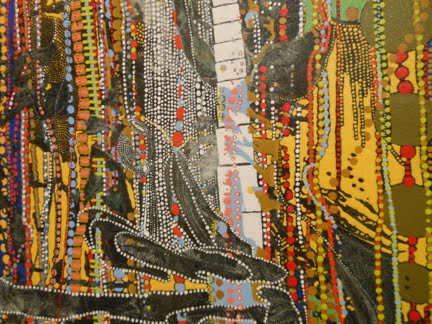
Claire Labonté's paintings are similarly intensively-worked. Her large acrylic pieces on cotton recall the dot-paintings of Australian aboriginals, and even the metal tapestries of El Anatsui.


large painting on cotton, Claire Labonté

detail, Claire Labonté

detail, Claire Labonté

Marigold Santos's paintings are shown in the basement, their luminescent paint revealed by the ultraviolet lighting. Her images reference weaving, knitting and braiding; body parts and landscape.


Forage, Marigold Santos

Forage, detail, Marigold Santos

Forage, detail, Marigold Santos

A review of the show from La Presse can be accessed here, and photos from the vernissage are available on-line.  John Pohl, of the Montreal Gazette, reviewed the show on November 19, 2016. The exhibition continues until December 18, 2016.

Sunday, October 30, 2016

Paper-clad mannequins at Berrington Hall

The grounds at Berrington Hall

While staying in Shropshire this summer, Hilary Gooding brought our little group to Berrington Hall, a National Trust property. It features an extravagantly furnished mansion, interesting gardens, and the final landscaping project of Capability Brown's long and illustrious career. This year marks the 300th anniversary of the birth of the famous landscape designer, and there was a special needlework exhibit on display that celebrated his life and times.

One of the many rooms, with its period furnishings

For me, one of the most intriguing aspects of the visit to Berrington Hall was the mannequins dressed in period costumes, all made of paper, not cloth. The artist is Denise Watson, and her beautifully costumed figures added a touch of life to the formidable formality of the house.


Don't stand too close to the fire!

Notice the hair, the lace and the "pearls", all created from paper.

Even the shoes were made of paper

I believe the central figure was meant to represent Capability Brown,
going over his landscape design with the architect (left), and the fellow on the right, described as a gardener.

Perhaps the whimsical treatment of the hair was meant
to signify his occupation.

This young miss's dress has a skirt with a sheer, polka dot overlay,
matching the lacy ruffle on her bonnet, all crafted from paper.

A family grouping adds warmth and scale to the elegant surroundings.
Notice the sheer layer on the dress of the little girl, to the left.

The docent explained that the paper clothing had been made especially for the venue, to celebrate the anniversary of Capability Brown. He also said that the artist wanted all the clothing destroyed when the exhibition ended. He said he hoped that something could be worked out that would allow the paper costumes to be on permanent exhibition there. I would like to think the staff at Berrington House had come to grow fond of their "paper dolls".